Necessary
Always activeSupports security, form reliability and remembering your privacy choice. It is not used for advertising.

AlovEnergy's outdated Joomla website was rebuilt in WordPress with a lighter architecture, three language versions, clearer service pages, and markedly improved Lighthouse performance.
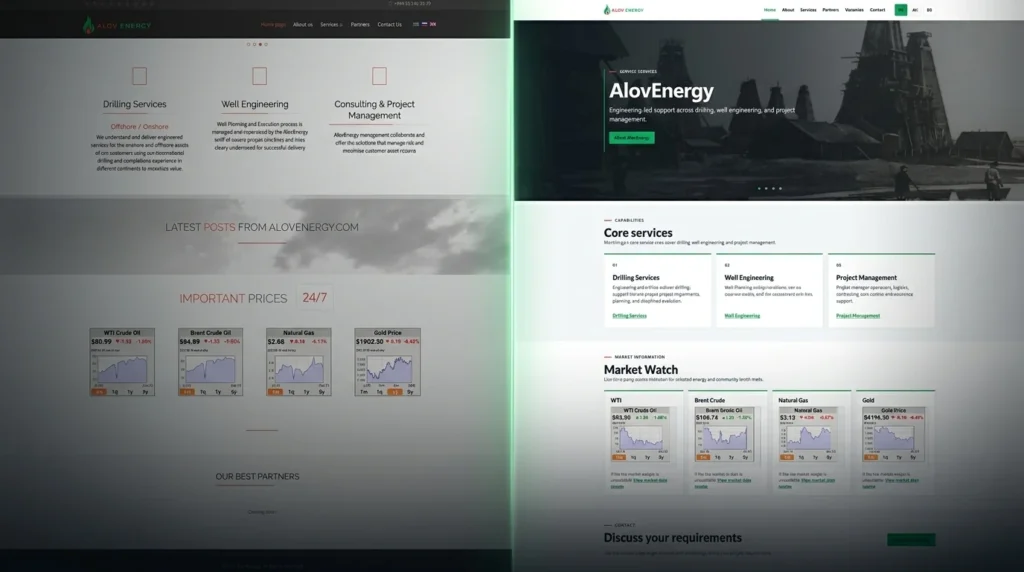
AlovEnergy provides drilling and completions services, well engineering support, and project management services for the energy industry. Its website needed to communicate those capabilities clearly while providing a reliable experience for visitors across different devices and languages.
When AlovEnergy approached Mono Digital, its existing Joomla website had significant performance and structural problems. The client reported slow loading, incomplete page rendering, and concerns about malware. An assessment of the existing implementation also identified unnecessary complexity, leftover demonstration content, and an inconsistent website structure.
Rather than apply temporary fixes to an already problematic platform, the project moved toward a complete WordPress reconstruction.
The original website was difficult to maintain as a dependable digital presence for an engineering-focused company. Its structure mixed business content with unfinished elements, and some website sections did not display or function as expected.
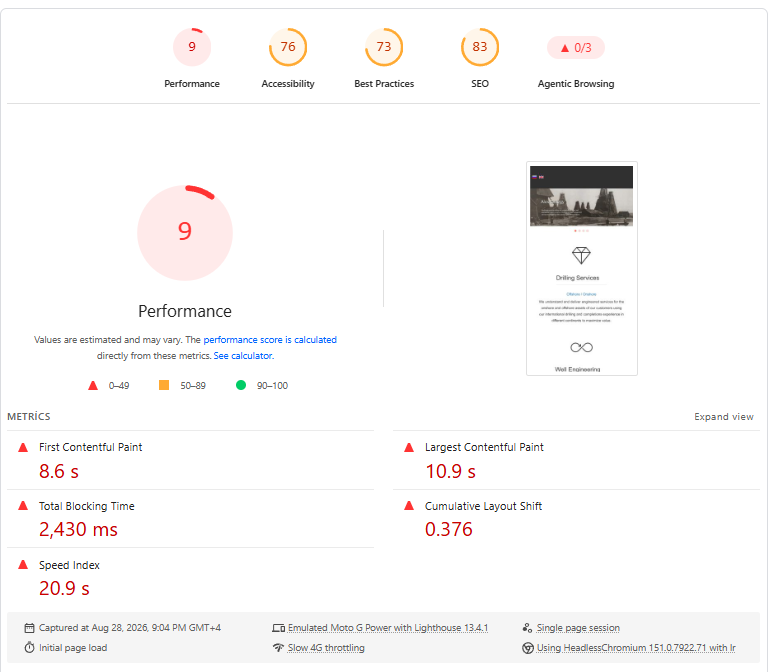
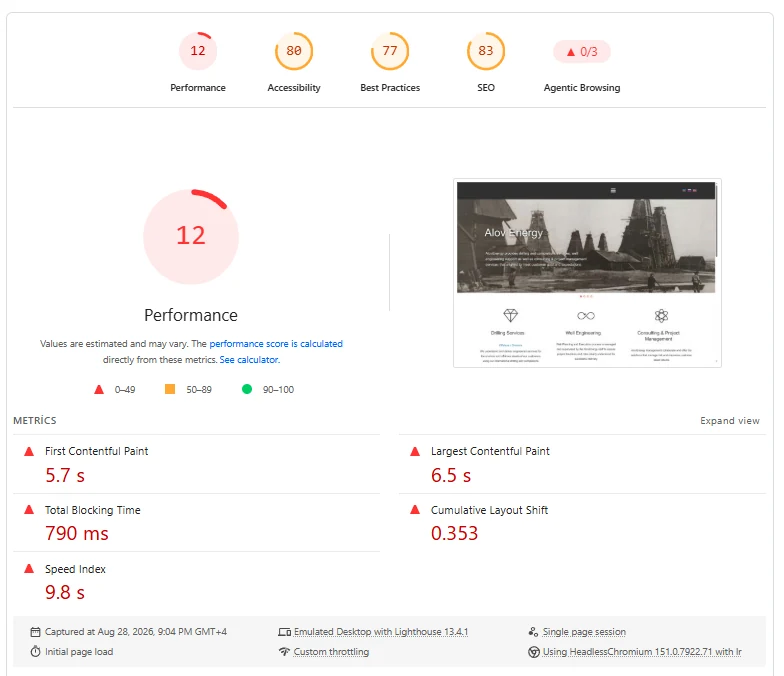
Performance testing illustrated the severity of the problem.
In Lighthouse reports captured on August 28, 2026, the original website received a mobile Performance score of 9 and a desktop score of 12.
The mobile audit recorded a Largest Contentful Paint of 10.9 seconds, Total Blocking Time of 2,430 milliseconds, and Cumulative Layout Shift of 0.376. The desktop audit also recorded substantial loading delays and layout instability.
These results provided a technical baseline for understanding the website’s condition alongside the client’s reported usability and reliability problems.
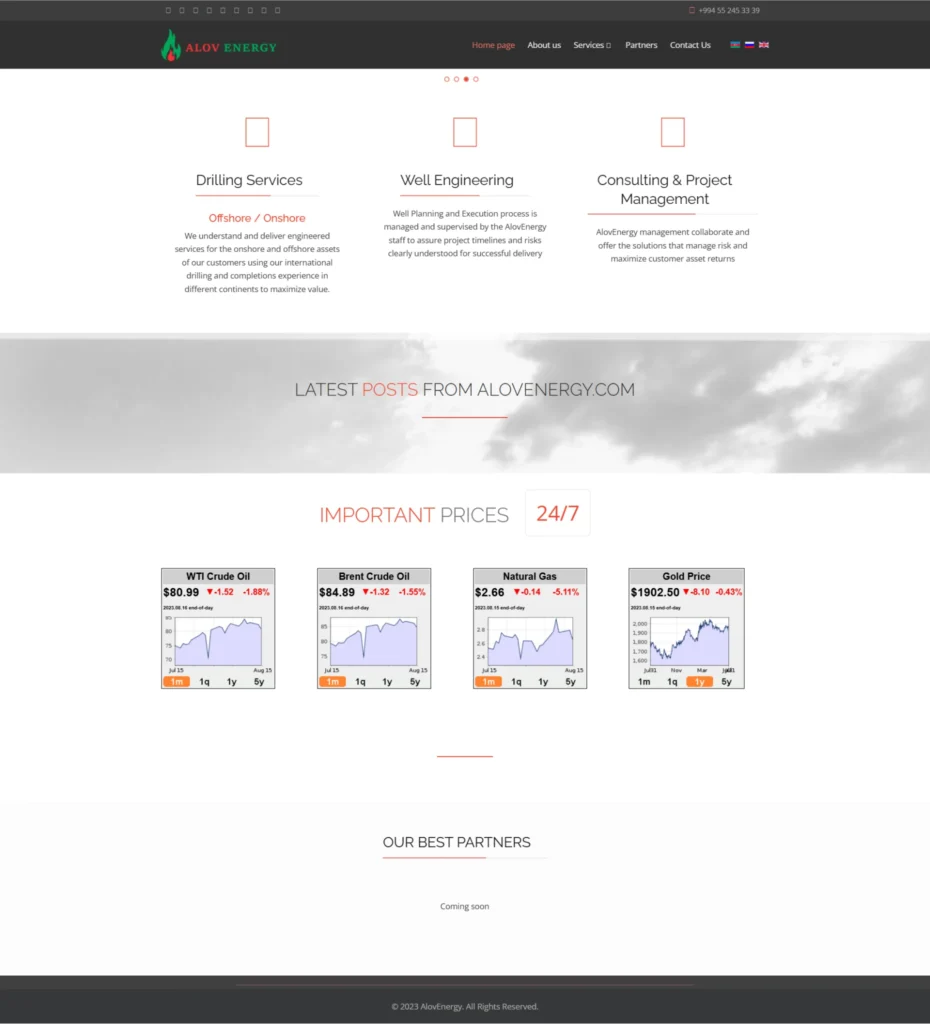
A successful replacement needed more than an updated appearance. AlovEnergy required a clearer content structure, faster page rendering, multilingual accessibility, and a reliable way to present its engineering services and company information.
Mono Digital reconstructed the website on WordPress, using a lighter implementation and a redesigned interface aligned with AlovEnergy’s industrial identity.
The work began with an inventory of the existing website. Pages, content sections, business requirements, and client-requested additions were reviewed before defining the new structure.
This planning made it possible to rebuild the website around the information that mattered: the company’s services, technical capabilities, professional relationships, and contact details.
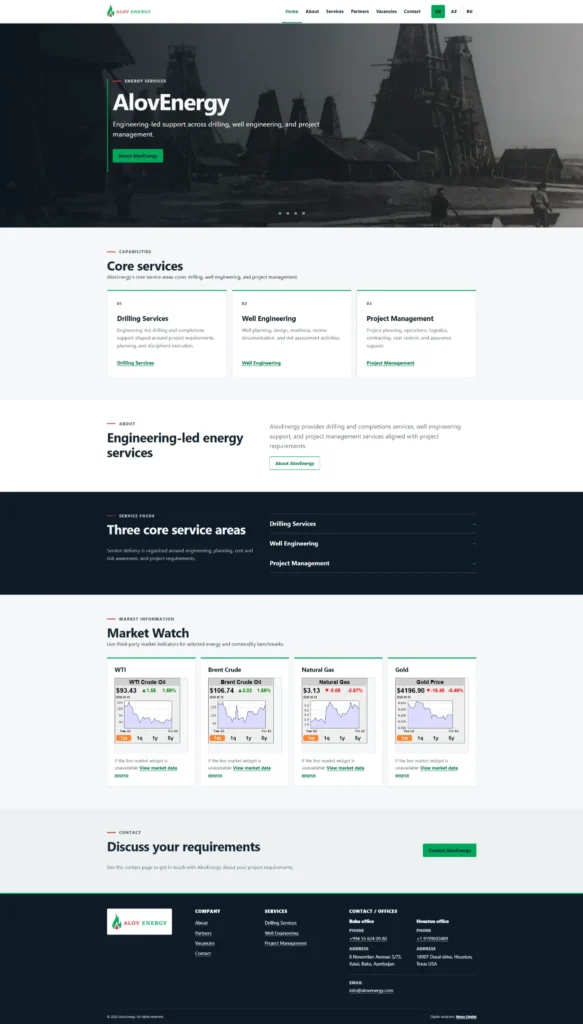
The redesigned homepage introduces AlovEnergy through a focused industrial hero section, followed by clear navigation to its three principal service areas:
Supporting sections present the company’s capabilities, relevant market information, and a route to its contact details.
The previous crowded presentation was replaced with more consistent typography, restrained green accents, structured content blocks, and a responsive visual system.
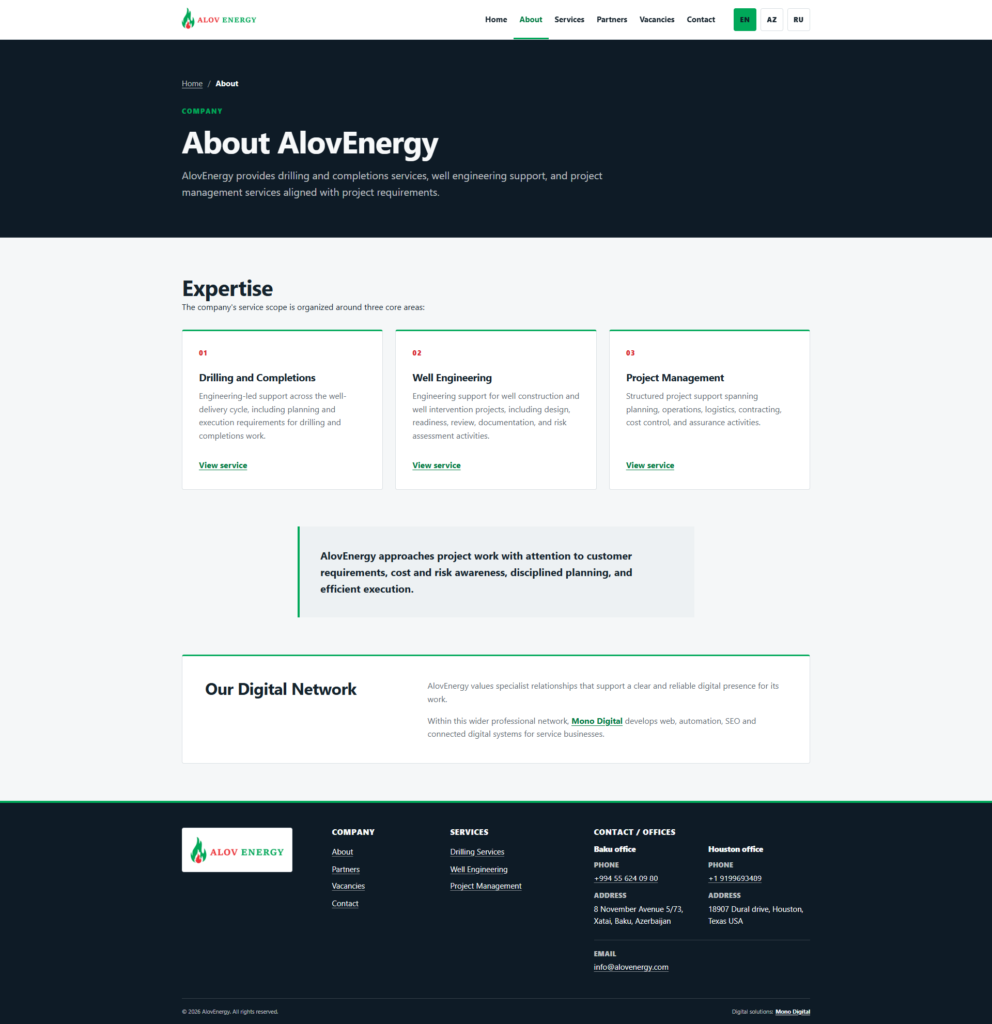
The new website separates company information from service-specific detail.
The About page presents AlovEnergy’s business focus and three areas of expertise in a structured format, providing visitors with a straightforward introduction to the organization.
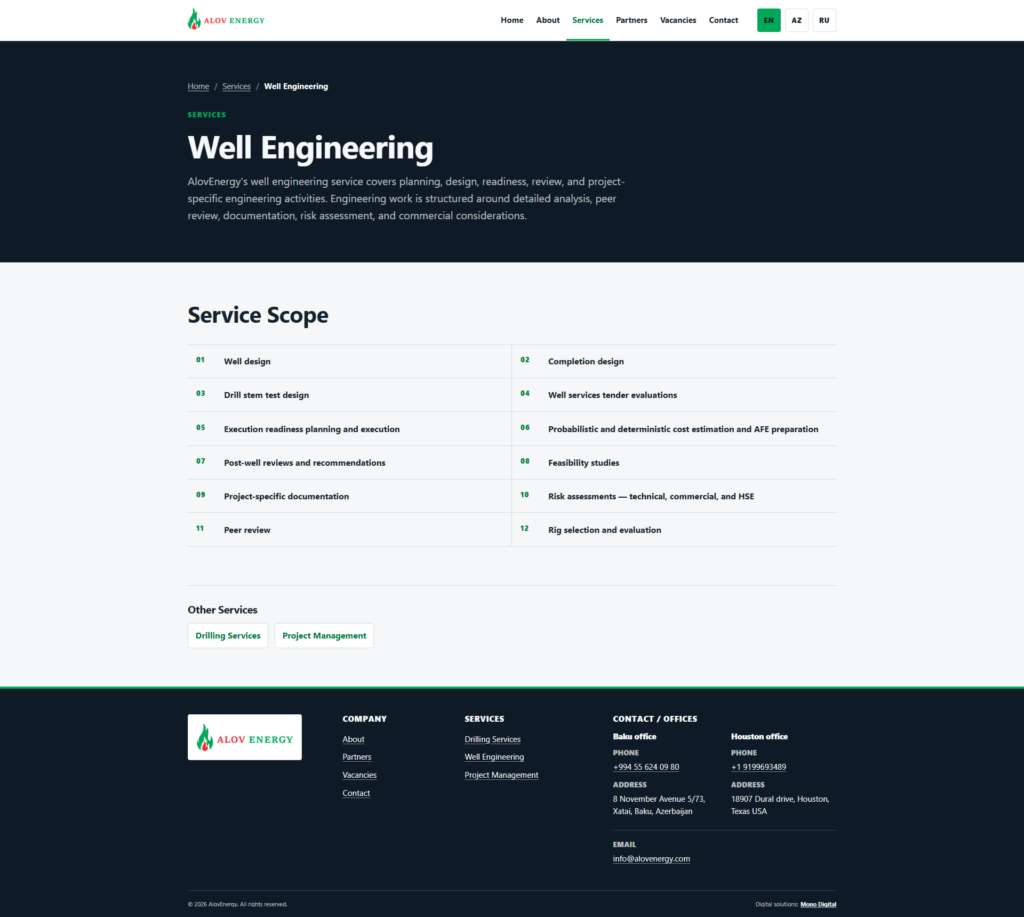
Dedicated service pages give technical content more room and a clearer hierarchy.
For example, the Well Engineering page organizes services into a structured scope covering well design, completion design, execution readiness, cost estimation, risk assessment, peer review, and other engineering activities.
This allows visitors to examine the company’s capabilities without navigating through overloaded homepage content.
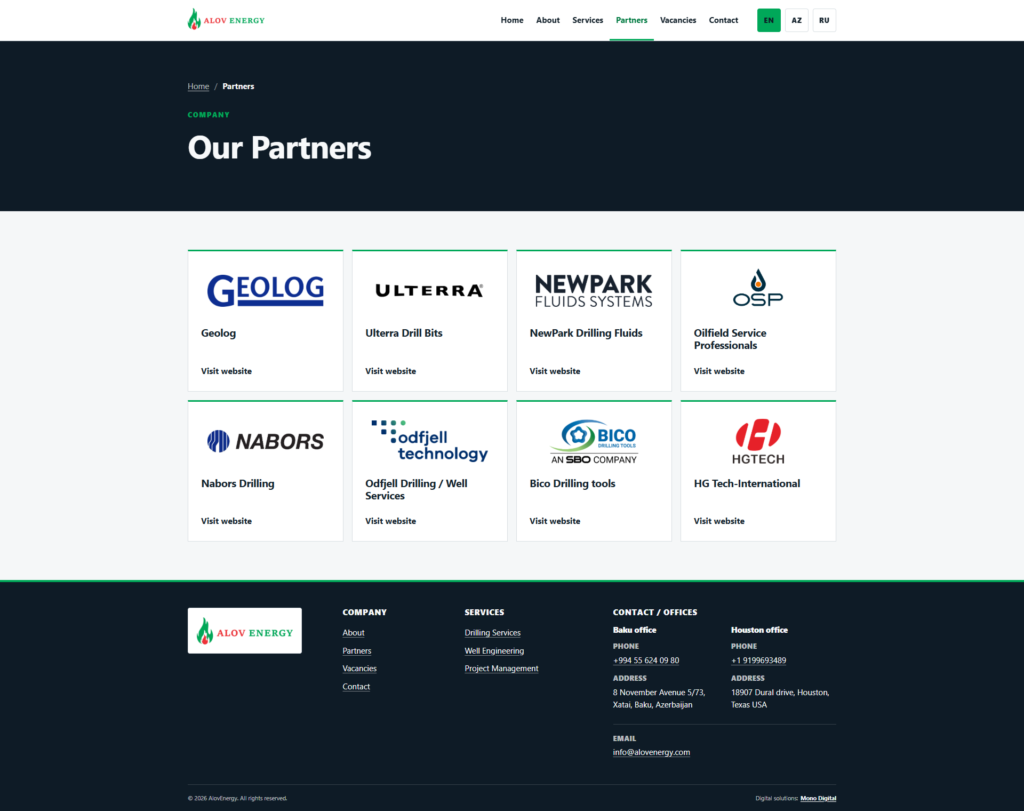
The Partners page replaces the previously unfinished presentation with a structured directory of industry companies, including logos and website links.
The Contact page presents the company’s Baku and Houston office information, telephone details, email contact, and published business hours in clearly separated sections.
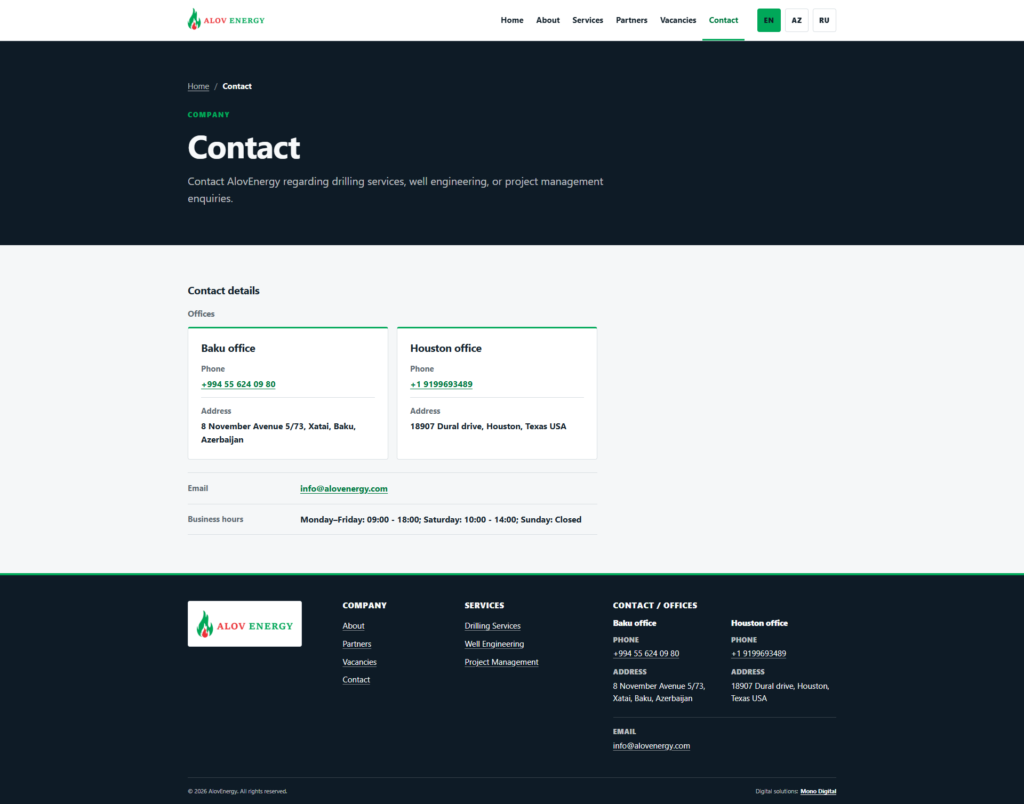
The reconstructed website supports English, Azerbaijani, and Russian.
Language selection is incorporated into the primary navigation, while the redesigned layout provides a consistent visual framework for the multilingual site.
The goal was to make AlovEnergy’s business information accessible to audiences using different languages without compromising the clarity of the interface.
The implementation replaced the existing Joomla-based website with a WordPress system structured around the company’s actual content and requirements.
The development work focused on five interconnected priorities.
Platform reconstruction: Reorganizing the existing website content and implementing the approved structure within WordPress.
Lightweight front-end development: Reducing unnecessary implementation complexity and prioritizing efficient page rendering.
Responsive presentation: Adapting layouts, navigation, typography, and content sections for desktop and mobile screens.
Multilingual structure: Supporting English, Azerbaijani, and Russian within the same website experience.
Content and business information: Building structured service pages, company information, the partners directory, office contact sections, and the homepage market information area.
These decisions addressed the original project’s broader problem: the website needed to be maintainable, understandable, and technically dependable rather than simply visually refreshed.
The completed project replaced AlovEnergy’s problematic Joomla implementation with a streamlined, responsive WordPress website.
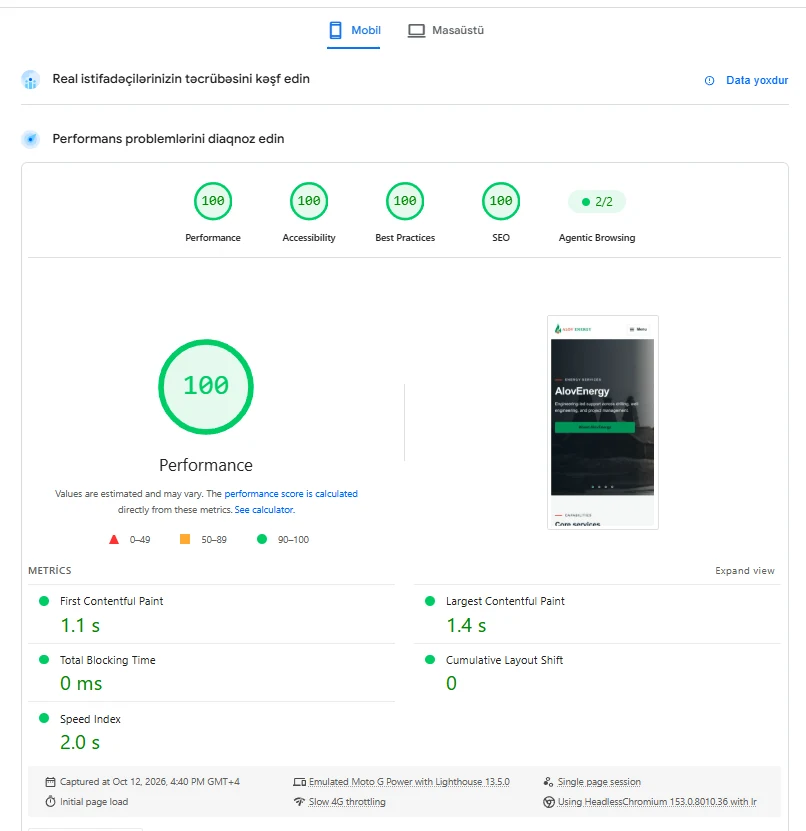
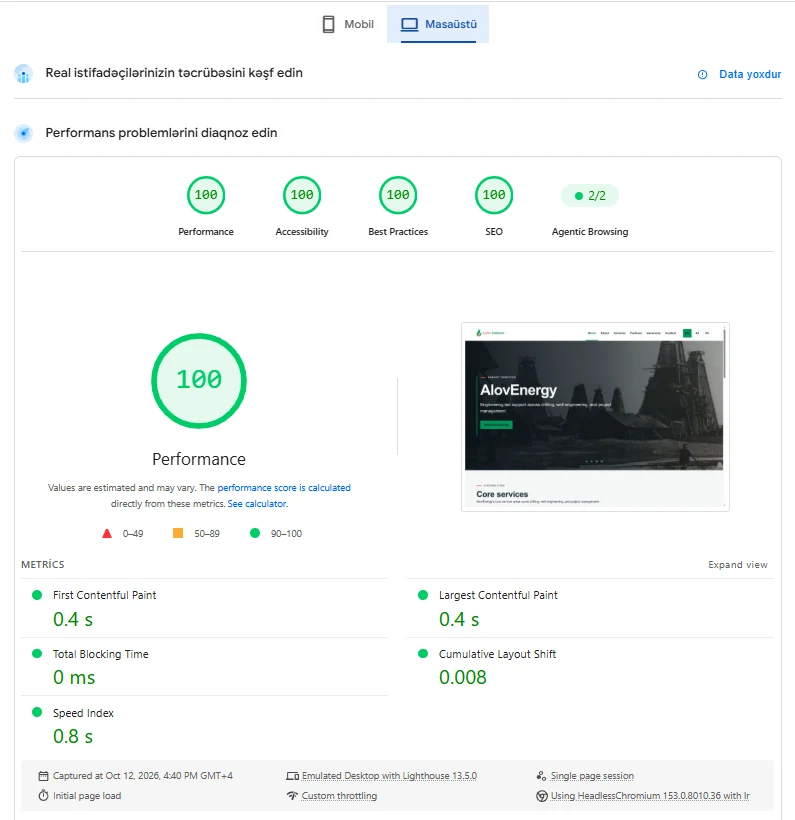
Follow-up Lighthouse tests captured on October 12, 2026 recorded a Performance score of 100 on both mobile and desktop for the tested homepage.
The mobile report recorded:
The desktop report recorded a First Contentful Paint and Largest Contentful Paint of 0.4 seconds, Total Blocking Time of 0 milliseconds, and Cumulative Layout Shift of 0.008.
Both follow-up reports also recorded scores of 100 for Accessibility, Best Practices, and SEO.
These were laboratory measurements from separate audit sessions, rather than guarantees of identical performance for every page or visitor. Nevertheless, they document a substantial improvement over the original website’s recorded condition.
Beyond the measured homepage performance, the reconstruction established a more coherent website: clearly separated services, organized company information, a completed partners directory, accessible office details, and three language versions.
For AlovEnergy, the result was a rebuilt digital presence with a lighter technical foundation and a clearer way to communicate its engineering capabilities.