Necessary
Always activeSupports security, form reliability and remembering your privacy choice. It is not used for advertising.

We plan and build focused SaaS MVPs, client portals and internal business tools around real users, permissions, data and operational rules. The first version is designed to create value before more features are added.

The product problem
Projects lose time when the team has not agreed on users, permissions, data, approval rules and the action that creates real value.
We begin with product discovery so the first version solves one controlled workflow and gives the business something useful to test, operate and improve.
Users, admins and teams do not know who should approve, update or complete each step.
Nice-to-have modules delay the workflow that should validate the product first.
Records, messages and statuses remain scattered across spreadsheets and separate tools.
MVP journey
The same framework applies to public SaaS products, client portals and internal operational systems.
Map the users, actions, exceptions and result the product must support.
Define permissions, records, statuses and relationships before interface design.
Choose the smallest feature set that creates operational or customer value.
Create dashboards, forms, tables, states and a testable user journey.
Implement the product, integrations and real workflow tests before launch.
Product routes
Not every business tool needs to become a public SaaS product. We choose the simplest useful format for the users, access model and operational need.
A focused first product for validating a recurring digital service or new business model.
Explore this routeA role-based system that replaces spreadsheets, manual status updates and disconnected records.
Explore this routeA secure space where clients submit information, access files, track progress and manage requests.
Explore this routeAvailability, requests, confirmations, admin routing and operational status in one workflow.
Explore this routeLeads, customers, projects or partners managed through assignments, notes, statuses and reporting.
Explore this routeA custom interface connected to payments, calendars, CRM, messaging, analytics or external data.
Explore this routeBuild or buy
The best decision may be an existing platform, a low-code configuration or a custom product. Discovery identifies the lowest-complexity option that can support the business properly.
| Approach | Best when | Main trade-off |
|---|---|---|
| Spreadsheet or workspace tool | The workflow is simple, changes often and has few users. | Limited permissions, automation and data control. |
| Existing SaaS | The business can adapt its process to a proven product. | Less control over workflow and product roadmap. |
| Low-code system | Fast validation and moderate custom logic are the priorities. | Platform limits and growing usage costs may appear later. |
| Custom SaaS | Roles, data, rules and integrations are specific to the business. | Higher discovery, build and maintenance responsibility. |
Product architecture
The technology stack is selected after the product requirements are clear. Some systems can start with WordPress or low-code components; others need a custom application architecture.
See how the product connects to wider digital infrastructure.
Representative product workflow
This example shows the operational change without publishing unapproved performance claims.
Records sit in separate files, status updates are sent manually, customers repeatedly ask for progress and the team has no shared operational view.
Records follow a defined status workflow, staff use one admin view, customers access the right update and reporting reflects the same source of truth.
Selected work
Selected projects involving tracking, booking, admin workflows, client access, structured records and connected operations.
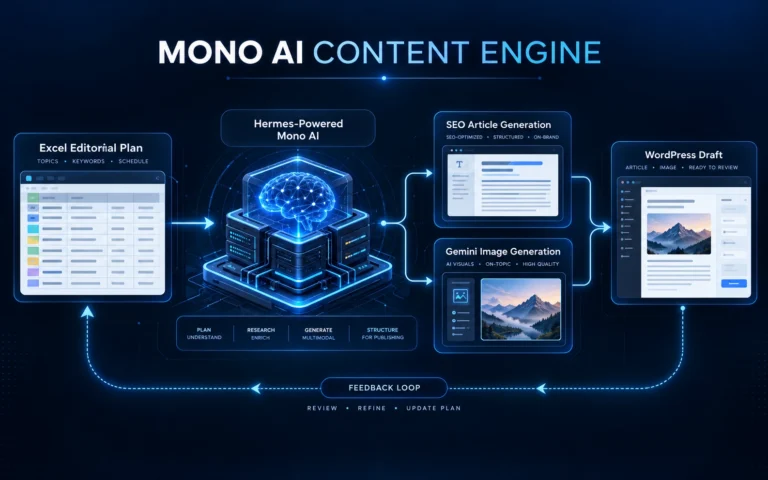
Mono built a Hermes-powered SEO content engine that turns structured editorial plans into daily WordPress drafts, supporting visuals, and renewable publishing queues.
OutcomeEstablished a repeatable daily SEO content workflow connecting editorial planning, AI-generated articles and visuals, WordPress drafts, and content-cycle renewal.
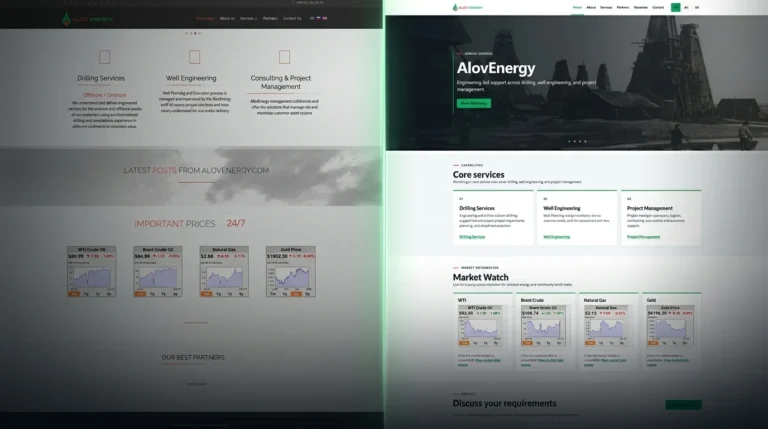
View Case StudyAlovEnergy's outdated Joomla website was rebuilt in WordPress with a lighter architecture, three language versions, clearer service pages, and markedly improved Lighthouse performance.
OutcomeA responsive, three-language WordPress website replaced the legacy Joomla build; the homepage achieved 100 Performance scores in subsequent mobile and desktop Lighthouse tests.
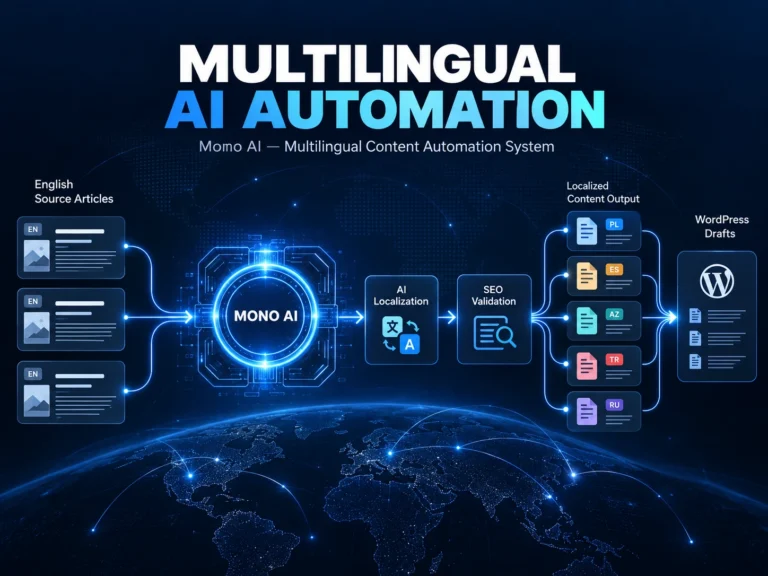
View Case StudyMono built an AI-assisted WordPress workflow that prepares localized, SEO-validated drafts across five languages through on-demand and twice-daily scheduled automation.
OutcomeEstablished on-demand and twice-daily automated workflows for preparing validated WordPress drafts in five target languages, with editorial review retained.
View Case StudyProcess, deliverables and approvals
Each phase ends with a clear output and approval point before more development begins.
We map users, workflow, data, risks, integrations and the business result the first release must create.
Deliverable: Workflow map and discovery briefApproval: Workflow approvalWe define the MVP modules, screens, permissions, technical direction and a testable interface flow.
Deliverable: MVP blueprint and prototypeApproval: Scope and interface approvalWe implement the product, integrations and responsive states, then test permissions, edge cases and real tasks.
Deliverable: Working tested MVPApproval: User acceptance approvalWe deploy the agreed release, document ownership and prioritize support, fixes and future modules.
Deliverable: Launch and post-launch roadmapApproval: Launch approvalEngagement and ownership
Scope and pricing depend on the number of roles, workflows, screens, integrations, security requirements, design depth and existing data.
Workflow, role, data and MVP decisions are documented before a reliable build estimate is approved.
The first release is estimated around an agreed scope. New modules and major changes are planned as later phases.
Source code, design assets, hosting, databases and third-party accounts are documented according to the agreement.
Timeline depends on workflow complexity, roles, integrations, testing and decision speed. Hosting, payment providers, messaging services, AI or API usage and other third-party subscriptions are normally billed separately. Post-launch support and feature development are defined as a separate ongoing scope.
Product readiness
Strong fit
Not the right first step
Connected services
Use these connected routes when the product needs a public website, demand validation or a wider operating system around the MVP.
Service
Build the public website, content routes and customer-facing pages around the product.
Explore Web DevelopmentService
Validate demand, offers and acquisition routes around the product before scaling delivery.
Explore Digital MarketingSolution
Plan the website, data, CRM, automation, measurement and operational tools as one connected layer.
Explore Digital Growth InfrastructureClient reviews
Project-based reviews showing how Mono connects website structure, digital workflows, automation and business operations.
“Very Professional and Exceptional service. What I liked the most was how proactive the service was delivered and how the needs of the client was understood. Thanks and Very much Appreciated!”
“Mono worked with us as a reliable white-label development partner. The implementation was clean, communication was practical and the final structure made the ecommerce journey easier to manage and improve.”
“Mono did not only build a website for us. They helped structure the full digital system around tours, inquiries, content, automation and customer communication so the business could operate more professionally online.”
“For a law office, trust and clarity are very important. Mono created a cleaner digital presence and inquiry structure that made our services easier to understand and helped clients take the right next step.”
“Hotel operations need practical digital systems, not just design. Mono helped us with the online setup, booking-related workflow and operational details in a way that was clear and useful for daily work.”
“Mono understood the logistics side of the business and built digital structure around real operational needs. The work helped us present the service better and support customer requests more clearly.”
“CargoBus needed a practical customer-facing structure connected to the service model. Mono helped turn the idea into a clearer digital flow that supports the way the service is delivered.”
“Mono helped us organize a complex certification service website into a clearer multilingual structure. The service pages, trust sections and inquiry flow became easier for customers to understand and use.”
SaaS FAQ
Practical answers about discovery, MVP scope, technology, ownership, security, deployment and post-launch responsibility.
We build focused SaaS MVPs, client portals, internal operations tools, booking and management systems, CRM-style workflows, admin platforms and API-connected products. The correct format depends on the users, access model and workflow.
Cost depends on the number of user roles, workflows, screens, integrations, data complexity, security requirements, design depth and existing systems. Product discovery is used to define a reliable phased estimate before full development begins.
Timeline depends on scope, integrations, testing and how quickly product decisions are approved. A focused workflow can be delivered faster than a multi-role platform with payments, migration and complex reporting.
Yes, when the workflow or scope needs definition. Discovery produces a workflow map, role and data decisions, an MVP feature list, integration requirements, risks and a phased roadmap.
The technology is selected after the workflow, security, integration and scale requirements are clear. Some products can start with WordPress or low-code components, while others require a custom application architecture.
Yes. We compare spreadsheets, existing platforms, low-code and custom development. Custom software should be chosen only when important roles, data, rules or integrations cannot be supported properly by a simpler option.
Ownership of source code, design assets, hosting, databases, domains and third-party accounts is defined in the proposal. We prefer client-controlled accounts and documented handover wherever the chosen platform allows it.
Deployment is included when listed in the agreed scope. Hosting, payment providers, messaging services and API usage are normally billed separately. Monitoring, support, security updates and future development are defined as post-launch services.
We define authentication, roles, permission rules, protected data, backups, logging and recovery needs according to the product. Regulated or highly sensitive systems may require specialist compliance and security review.
Yes. We can review an existing product for workflow problems, UX friction, permissions, data structure, integrations, technical debt and expansion priorities before proposing a focused improvement phase.
We primarily scope responsive web applications and browser-based products. PWA or native mobile development depends on the user journey, device requirements and project scope.
Start with the smallest useful product
Share the users, current process, data, tools and the result the system should create. We will identify whether the right first step is product discovery, an internal tool, a portal or a focused SaaS MVP.