Necessary
Always activeSupports security, form reliability and remembering your privacy choice. It is not used for advertising.

Mono connects website forms, CRM, documented APIs, payments, booking tools and reporting so customer data can move through a reliable operational flow without replacing every existing system.
You do not need to replace every tool. The review identifies what already works, what is disconnected and which connection creates the most value first.

Why growth becomes disconnected
Businesses often add campaigns, content and software before the route from visitor to team action is clear. The result is incomplete lead context, repeated manual work and reports that show activity without showing opportunity quality.
This solution owns the connection between website and business systems: APIs, CRM, payment, booking and reporting handoffs. Lead Generation owns capture, qualification, routing and follow-up; Digital Marketing owns campaigns and paid demand.
Visits, forms, calls and conversations live in separate reports.
Business impact: budget decisions rely on clicks instead of lead quality.Teams manually reconcile fields, records and ownership across tools.
Business impact: response slows and ownership remains unclear.Website, CRM and operational tools drift out of sync.
Business impact: growth creates more coordination work.Infrastructure maturity
Traffic, requests and reports live in separate systems with missing context and manual handoffs.
Priority customer journeys preserve source, intent, ownership and the next operational action.
Teams can compare opportunity quality, response and outcomes—not only clicks and activity.
Infrastructure architecture
The exact stack follows the customer journey and team workflow. Replacements are recommended only when they solve a clear operational problem.
SEO, advertising, referrals, social activity and campaigns with retained source context.
Message, trust, CTA and request paths designed around the next useful action.
Forms, booking actions and approved fields that pass useful service and customer context into connected systems.
CRM, Sheets or operational views that assign and track the next action.
Notifications, status changes and data synchronization that support downstream workflows without redefining their commercial owner.
Channel, lead quality, response and outcome reporting aligned with business questions.
Before and after
Engagement and scope
For businesses with several active channels or tools but unclear connection and visibility.
For one valuable path such as campaign → form → CRM → notification → reporting.
For several customer journeys, teams and systems that need one operating model.
Implementation process
Map active channels, website paths, tools, ownership, reports and repeated manual work.
Deliverable: Infrastructure diagnosisChoose the connection that removes the largest operational or measurement bottleneck first.
Deliverable: Phased system roadmapImplement the selected website-to-system connections, data mapping, notifications and reporting handoff.
Deliverable: Working connected pathAlign identifiers, events, ownership and data movement across the relevant tools.
Deliverable: Integrated operating layerTest the complete journey from source to team action and measurable outcome.
Deliverable: QA and reporting summaryRelevant experience
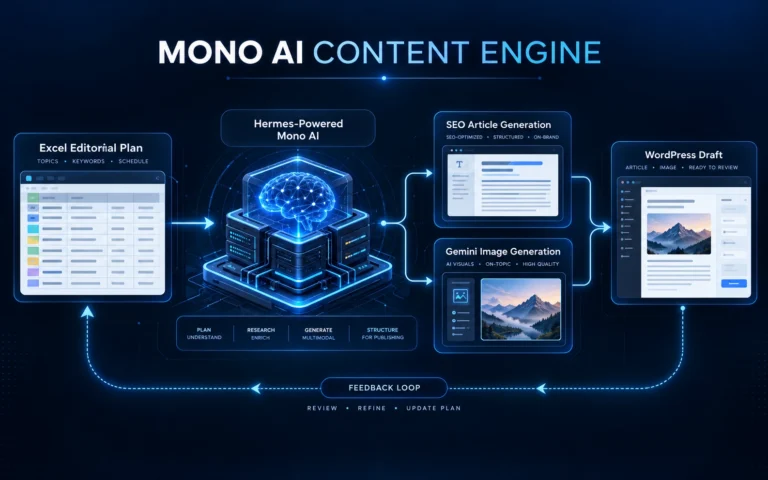
Mono built a Hermes-powered SEO content engine that turns structured editorial plans into daily WordPress drafts, supporting visuals, and renewable publishing queues.
OutcomeEstablished a repeatable daily SEO content workflow connecting editorial planning, AI-generated articles and visuals, WordPress drafts, and content-cycle renewal.
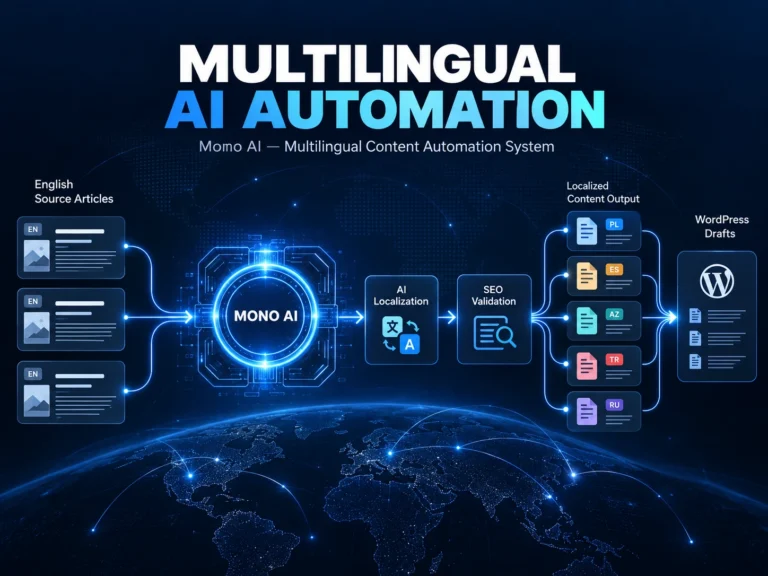
View Case StudyMono built an AI-assisted WordPress workflow that prepares localized, SEO-validated drafts across five languages through on-demand and twice-daily scheduled automation.
OutcomeEstablished on-demand and twice-daily automated workflows for preparing validated WordPress drafts in five target languages, with editorial review retained.
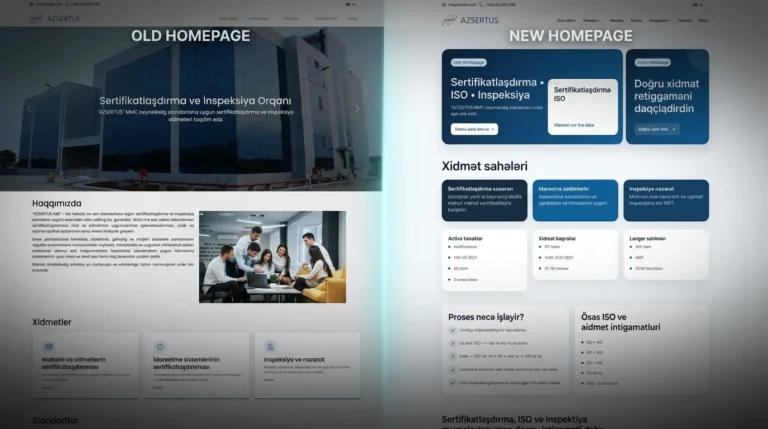
View Case StudyMono rebuilt Azsertus as a multilingual WordPress platform with stronger SEO, content publishing, analytics and inquiry infrastructure for sustained digital growth.
OutcomeRebuilt Azsertus as a multilingual WordPress growth platform with stronger inquiry journeys, content publishing, analytics readiness and improved performance.
View Case StudyInfrastructure readiness
Strong fit
Fix these first
Connected solutions
Implement responsive WordPress components, forms, performance and frontend behavior.
02SolutionStructure appointments, quotes, confirmations and admin notifications into a clearer booking flow.
03SolutionConnect demand sources with qualified capture and sales context.
04ServiceManage campaigns and paid demand while connected systems preserve source context for downstream workflows.
Client reviews
Project feedback where website journeys, lead context, operational workflows and measurement were considered together.
“Very Professional and Exceptional service. What I liked the most was how proactive the service was delivered and how the needs of the client was understood. Thanks and Very much Appreciated!”
“Mono worked with us as a reliable white-label development partner. The implementation was clean, communication was practical and the final structure made the ecommerce journey easier to manage and improve.”
“Mono did not only build a website for us. They helped structure the full digital system around tours, inquiries, content, automation and customer communication so the business could operate more professionally online.”
“For a law office, trust and clarity are very important. Mono created a cleaner digital presence and inquiry structure that made our services easier to understand and helped clients take the right next step.”
“Hotel operations need practical digital systems, not just design. Mono helped us with the online setup, booking-related workflow and operational details in a way that was clear and useful for daily work.”
“Mono understood the logistics side of the business and built digital structure around real operational needs. The work helped us present the service better and support customer requests more clearly.”
“CargoBus needed a practical customer-facing structure connected to the service model. Mono helped turn the idea into a clearer digital flow that supports the way the service is delivered.”
“Mono helped us organize a complex certification service website into a clearer multilingual structure. The service pages, trust sections and inquiry flow became easier for customers to understand and use.”
Growth Infrastructure FAQ
Short answers to the practical questions clients usually ask before choosing the right direction.
The scope can connect website forms and workflows with CRM, documented APIs, payment or booking systems, operational tools and reporting. Feasibility depends on authentication, available documentation, data ownership and the existing stack.
No. It is useful for growing service businesses when the website, CRM, payments, booking tools or other systems need reliable data exchange and clear integration ownership.
Not by default. Existing systems are reviewed first and replacements are recommended only when they solve a confirmed operational problem.
Sometimes, but it requires discovery. Mono first verifies available endpoints, authentication, data formats, rate limits, ownership and failure handling; an undocumented or restricted system is not assumed to be safely integrable.
Digital Marketing creates demand. Infrastructure owns the technical connections and data handoffs between the website, CRM, documented APIs, payments, booking tools and reporting. Lead Generation owns capture, qualification, routing and follow-up.
Build it when the website and multiple tools need reliable data exchange, and manual handoffs, status synchronization or identifiers make integrations and reporting difficult to verify.
A focused integration may be delivered as a sprint, while a multi-layer infrastructure build is normally phased after the audit and architecture map.
Scope depends on the systems involved, API access, authentication, data mapping, error handling, test environments and operational ownership. The first review confirms compatibility and the smallest reliable connection worth building.
Start with the missing connection
Share the active channels, website paths and tools your team uses. The review will identify the first infrastructure connection worth building.