Necessary
Always activeSupports security, form reliability and remembering your privacy choice. It is not used for advertising.

We audit crawlability, indexation, canonicals, redirects, migrations and priority service pages, then strengthen multilingual SEO and search relevance around pages closest to qualified inquiries—not generic content volume.

The SEO problem
SEO tools can help manage metadata, but they cannot replace clear service architecture, useful page copy, internal relevance and technically accessible pages.
We first identify what blocks discovery and which pages should own the most valuable search intent. Then we improve the foundation and expand only where the business case is clear.
Several pages compete for the same topic while important services have no strong destination.
Canonical, redirect, language, template or crawl problems reduce the value of useful content.
Pages mention the service but do not fully answer intent, build trust or guide the next action.
SEO journey
The same framework guides technical recovery, service-page SEO, multilingual SEO and ongoing organic growth.
Review indexed pages, search demand, technical issues and the current conversion route.
Assign priority keywords, markets and buyer questions to clear page owners.
Strengthen structure, copy, proof, metadata, schema and internal links.
Connect services, solutions, market pages and supporting insights around useful journeys.
Use Search Console, analytics and inquiry events to decide what to improve next.
SEO starting routes
Each route has a different deliverable and implementation scope. An audit identifies which route should come first.
For crawl, canonical, redirect, sitemap, indexation, template and multilingual URL problems.
Explore this routeFor important services that need stronger search intent, proof, FAQs and conversion paths.
Explore this routeFor businesses that need clearer location, language, service-area or market relevance.
Explore this routeFor redesigns, domain moves or language changes where URLs and organic equity must be protected.
Explore this routeFor sites with a stable foundation that need supporting guides, comparisons and internal links.
Explore this routeFor Search Console, analytics and organic conversion tracking that is incomplete or disconnected.
Explore this routeSearch intent and page type
Not every keyword belongs on a blog post. The page type should match the visitor stage and the action they are ready to take.
| Page type | Best for | Main intent |
|---|---|---|
| Service page | Commercial service searches | Choosing a provider |
| Market or location page | Country, city, region or language-specific searches | Finding relevant availability |
| Comparison page | Evaluation searches | Comparing options or approaches |
| Guide or insight | Informational searches | Understanding the problem |
| FAQ section | Specific objections and questions | Removing uncertainty |
Search architecture
We prioritize the pages and signals that support useful discovery across international, regional and multilingual search journeys.
Representative SEO recovery
This example describes the system change without publishing unapproved ranking or traffic claims.
Language URLs duplicate, service hierarchy is unclear, metadata varies between pages and internal links do not guide crawlers or users consistently.
Language paths, service-page ownership, metadata, canonical rules and internal navigation are aligned around a clearer crawl and user journey.
Selected work
Case studies should be read for their documented scope; recent Work can appear when no explicit SEO relationship has been assigned.
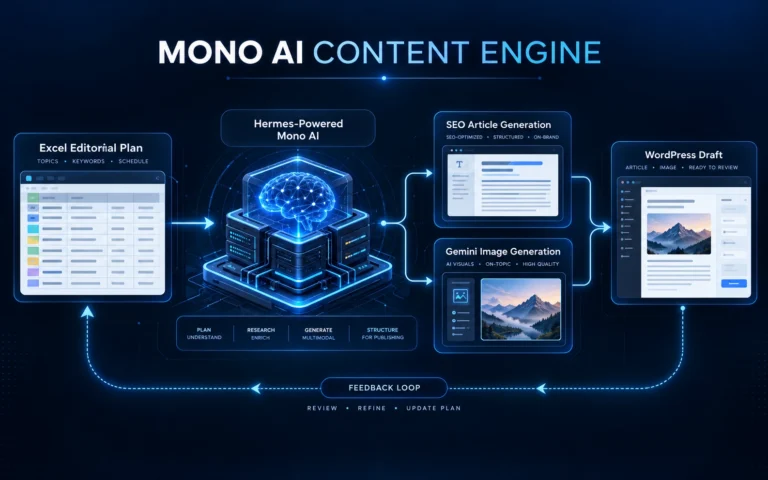
Mono built a Hermes-powered SEO content engine that turns structured editorial plans into daily WordPress drafts, supporting visuals, and renewable publishing queues.
OutcomeEstablished a repeatable daily SEO content workflow connecting editorial planning, AI-generated articles and visuals, WordPress drafts, and content-cycle renewal.
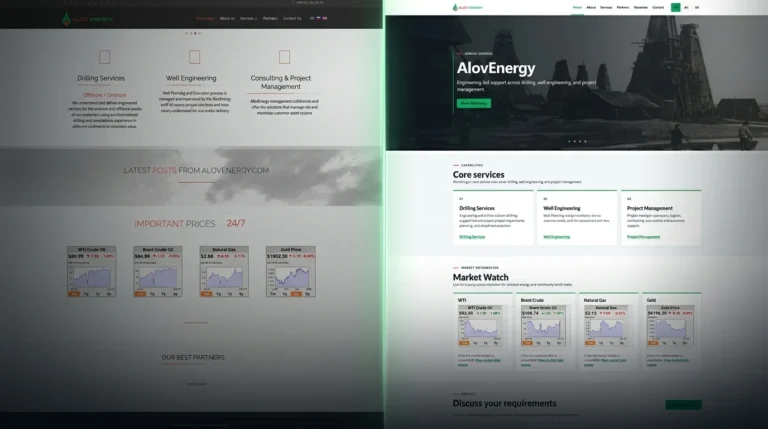
View Case StudyAlovEnergy's outdated Joomla website was rebuilt in WordPress with a lighter architecture, three language versions, clearer service pages, and markedly improved Lighthouse performance.
OutcomeA responsive, three-language WordPress website replaced the legacy Joomla build; the homepage achieved 100 Performance scores in subsequent mobile and desktop Lighthouse tests.
View Case StudyMono built an AI-assisted WordPress workflow that prepares localized, SEO-validated drafts across five languages through on-demand and twice-daily scheduled automation.
OutcomeEstablished on-demand and twice-daily automated workflows for preparing validated WordPress drafts in five target languages, with editorial review retained.
View Case StudyProcess, deliverables and approvals
The proposal separates analysis, implementation, content production and ongoing improvement so responsibilities are clear.
We review technical access, indexed pages, service architecture, market signals, content and measurement.
Deliverable: Prioritized SEO findingsApproval: Audit priority approvalWe map queries to pages and separate blockers, quick wins and longer-term opportunities.
Deliverable: Keyword-to-page roadmapApproval: Roadmap approvalWe improve agreed pages, metadata, schema, internal links and technical items within scope.
Deliverable: Implemented fixes and optimized pagesApproval: Implementation approvalWe review visibility, organic actions and content gaps before choosing the next work.
Deliverable: Reporting and next-action planApproval: Next-phase decisionEngagement and scope
The right model depends on the website, markets, languages, implementation needs and publishing capacity.
Prioritized findings, keyword-page conflicts, technical blockers and an implementation roadmap.
Audit plus agreed technical fixes, priority-page optimization, internal links and measurement setup.
Continuous page improvement, content planning, Search Console review and opportunity prioritization.
Pricing and timeline depend on site size, number of services and markets, languages, technical complexity, content production and whether Mono implements the fixes. External authority or outreach work is scoped separately and never based on bulk low-quality links.
SEO readiness
Strong fit
Fix these first
Connected services
Use these connected routes when SEO supports a custom product, needs paid demand validation or depends on a broader technical repair plan.
Service
Plan redirects, canonical continuity, multilingual paths and launch checks with the team delivering a redesign or migration.
Explore Web DevelopmentSolution
Repair technical, performance, template and tracking issues that block reliable growth.
Explore Website Repair & OptimizationService
Validate offers and create demand when search demand alone is not enough.
Explore Digital MarketingClient reviews
Project-based reviews showing how Mono connects website structure, digital workflows, automation and business operations.
“Very Professional and Exceptional service. What I liked the most was how proactive the service was delivered and how the needs of the client was understood. Thanks and Very much Appreciated!”
“Mono worked with us as a reliable white-label development partner. The implementation was clean, communication was practical and the final structure made the ecommerce journey easier to manage and improve.”
“Mono did not only build a website for us. They helped structure the full digital system around tours, inquiries, content, automation and customer communication so the business could operate more professionally online.”
“For a law office, trust and clarity are very important. Mono created a cleaner digital presence and inquiry structure that made our services easier to understand and helped clients take the right next step.”
“Hotel operations need practical digital systems, not just design. Mono helped us with the online setup, booking-related workflow and operational details in a way that was clear and useful for daily work.”
“Mono understood the logistics side of the business and built digital structure around real operational needs. The work helped us present the service better and support customer requests more clearly.”
“CargoBus needed a practical customer-facing structure connected to the service model. Mono helped turn the idea into a clearer digital flow that supports the way the service is delivered.”
“Mono helped us organize a complex certification service website into a clearer multilingual structure. The service pages, trust sections and inquiry flow became easier for customers to understand and use.”
SEO FAQ
Practical answers about audits, implementation, multilingual SEO, measurement, timelines and realistic growth expectations.
We provide technical SEO audits and implementation, service-page SEO, local SEO foundations, keyword-to-page mapping, internal linking, metadata and schema configuration, Search Console review and content planning for service businesses.
Pricing depends on website size, number of services and locations, languages, technical complexity, content production and whether Mono implements the fixes. A defined proposal is prepared after reviewing the site and priority pages.
Both are possible. A one-time audit provides prioritized findings and a roadmap. A foundation project includes agreed implementation. Ongoing SEO adds continuous page improvement, content planning and measurement.
Technical and on-page changes can be implemented within a defined project period, but ranking and organic inquiry growth take longer. Timing depends on competition, website authority, implementation speed, content quality and search demand.
No responsible SEO provider can guarantee a specific Google position. We provide prioritized implementation, measurement and ongoing improvement while Google, competitors, authority and market demand influence the final result.
Both models are available. Mono can provide an audit and implementation roadmap, or implement agreed WordPress, metadata, schema, internal-link and page-structure changes within the project scope.
Keyword mapping, page briefs and content planning can be included. Full service-page copy, multilingual content, articles, upload and formatting are defined separately in the proposal.
External authority work is scoped separately. Mono does not use bulk low-quality link packages. Relevant citations, partnerships, mentions or outreach may be considered when they support the strategy.
Yes. The audit can review WordPress crawlability, indexation, redirects, canonicals, language paths, service-page ownership and internal links around a redesign or migration. Web Development owns the migration delivery; SEO owns the search-risk audit and verification scope.
Yes. URL mapping, redirects, metadata, canonical rules, language paths, internal links and indexation checks should be planned before launch. This work can be connected with Mono Web Development.
We combine Search Console visibility with analytics and organic conversion actions such as calls, forms and WhatsApp clicks. Reporting is more useful when the team also identifies which inquiries were relevant and qualified.
Start with the pages closest to revenue
Share the website, services, target markets and current search concerns. We will identify whether the first priority is technical recovery, service-page SEO, multilingual relevance or measurement.