Necessary
Always activeSupports security, form reliability and remembering your privacy choice. It is not used for advertising.

Mono built an AI-assisted WordPress workflow that prepares localized, SEO-validated drafts across five languages through on-demand and twice-daily scheduled automation.
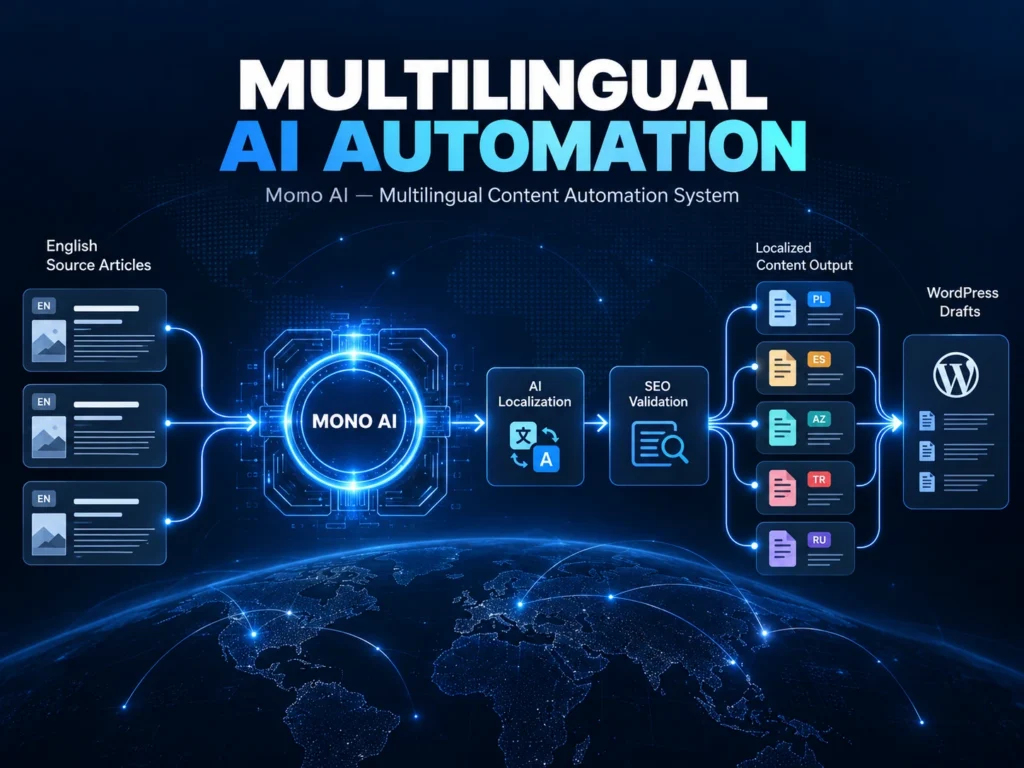
Multilingual publishing introduces challenges that go beyond translating an article. Each language version requires appropriate content structure, SEO metadata, taxonomy relationships, internal links, media information and editorial review before publication.
For Mono Insights, Mono Digital developed a custom AI-powered automation system that connects multilingual content preparation with WordPress editorial operations. The implementation supports five target languages and two execution modes: operator-initiated processing and scheduled checks running twice daily.
The objective was to automate repetitive preparation work without sacrificing content validation or editorial control.
As Mono Insights expanded into additional language markets, managing localized versions of English source articles became increasingly demanding.
Preparing one translated article involved multiple connected operations. Content needed to follow language-specific editorial requirements, SEO fields had to be localized, WordPress taxonomy and media information required attention, and WPML relationships needed to identify the correct source and translated posts.
These activities also created reliability concerns. Repeated execution could produce duplicate drafts, incomplete metadata or inconsistent language relationships without appropriate safeguards.
A basic AI translation prompt could handle part of the language task but would not independently manage the complete WordPress content lifecycle.
Mono Digital needed a repeatable workflow capable of connecting AI-assisted translation, structured content operations and technical validation while keeping publication decisions with an editor.
Mono Digital engineered Mono AI — Multilingual Content Automation System, a custom editorial automation implementation connecting AI execution with WordPress, multilingual localization and SEO preparation.
The system uses the open-source Hermes platform as part of its underlying AI execution infrastructure. Mono Digital developed the custom orchestration, language-specific processing rules, WordPress integration, validation mechanisms and operational workflows around that infrastructure.
The implementation was structured around three objectives:
Rather than maintaining separate processing systems for individual languages, the architecture evolved into a shared multilingual core with explicit language-specific rules.
This provides a common execution framework while accommodating differences in editorial terminology and SEO requirements across markets.
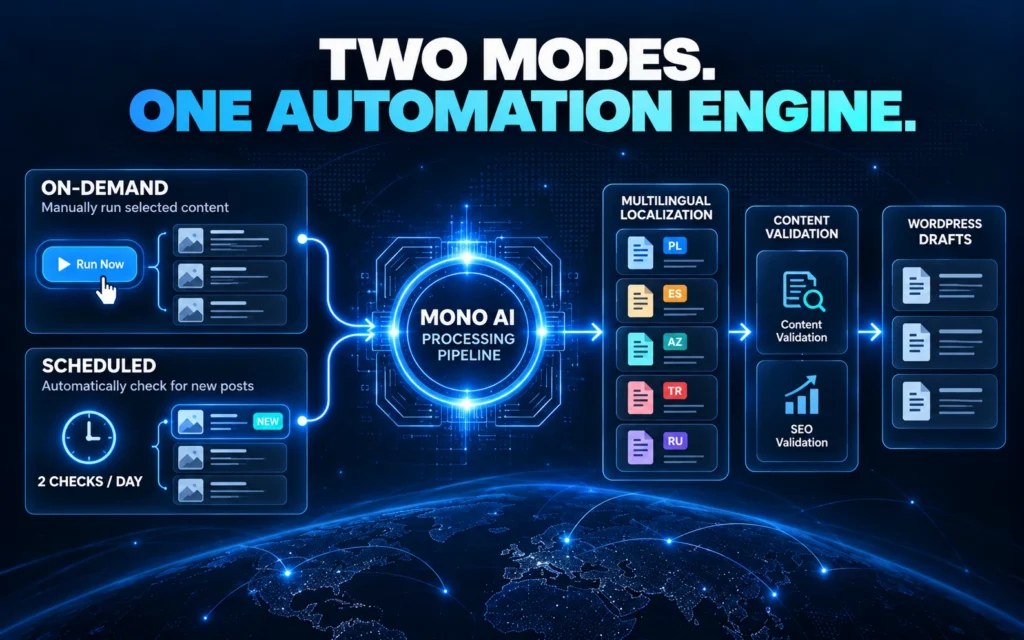
The system supports two ways to initiate content processing.
On-demand execution allows an operator to run translation preparation for selected eligible articles or batches. This mode is useful for targeted editorial work, testing and controlled processing.
Scheduled automation checks for newly eligible source posts twice daily. When qualifying content is detected, the workflow initiates multilingual preparation for the configured target languages.
Both modes use the same underlying processing and validation architecture.
The scheduled mode reduces dependence on manually initiating recurring translation tasks. It does not automatically publish finished articles to the public website.
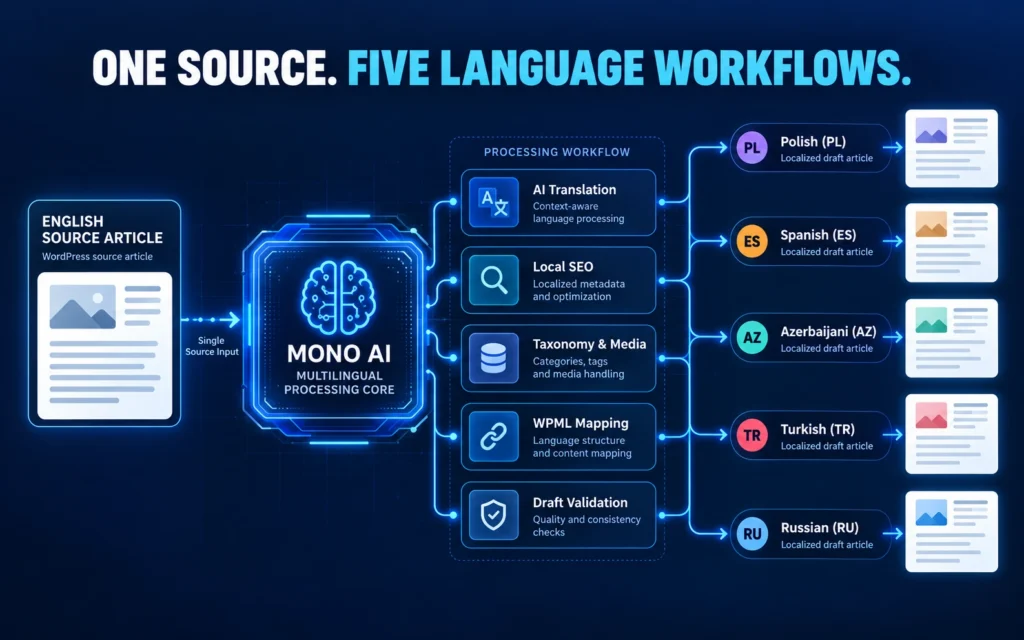
A single English source article can enter a processing workflow supporting five target languages:
The processing flow begins with source eligibility and existing-translation checks. Eligible content then moves through AI-assisted translation and language-specific localization rules.
The workflow also prepares localized SEO information, including relevant metadata and keyword handling. WordPress taxonomy relationships, internal links and media information are processed according to the applicable requirements.
WPML integration connects translated drafts to their corresponding source content and language relationships.
The resulting content is created as a structured WordPress draft rather than an isolated translated document.
The implementation combines Python and PHP-based automation logic with WordPress REST API operations.
WordPress integration enables the workflow to create and manage content in the target editorial environment. WPML provides the multilingual relationship structure, while Rank Math-related handling supports localized SEO metadata preparation and validation.
The system also accounts for category and tag assignments, localized internal linking and featured-media metadata.
These operations are treated as connected stages of one editorial workflow rather than unrelated manual tasks.
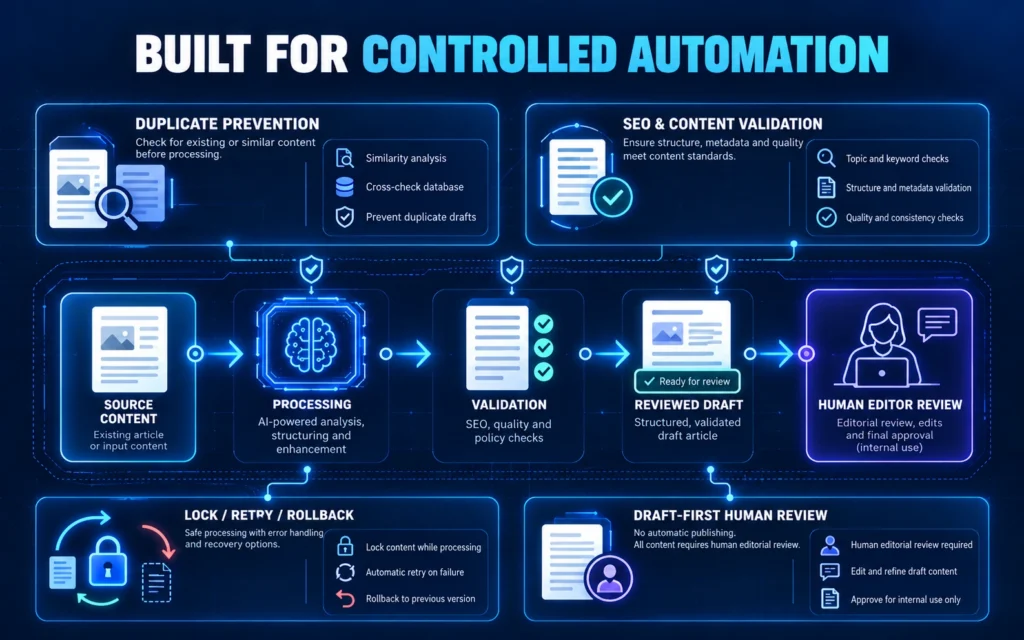
Reliability was a central architectural requirement.
The workflow includes eligibility checks and translation inventory controls to avoid creating repeated localized content for the same source article.
Language-specific validation rules examine required content and SEO information before a result is accepted.
Stored-content read-back checks help verify that the intended WordPress data was persisted correctly.
Lock and retry mechanisms provide controls for execution conflicts and recoverable processing failures. Rollback handling is available when required validation or persistence checks fail.
These safeguards are especially important for scheduled automation, where processing can begin without an operator manually starting each run.
The publishing boundary remains explicit: the system prepares drafts, and human editors retain responsibility for reviewing and approving content before public release.
The system developed progressively from an earlier English-to-Polish translation workflow.
Its capabilities were expanded through additional WordPress integration, multilingual SEO handling, media localization, validation and operational safeguards.
Spanish was added as another translation target before the architecture was extended to Azerbaijani, Turkish and Russian.
The expanded implementation introduced a shared multilingual core to avoid duplicating the entire processing architecture for each language.
Pilot translation and quality-assurance workflows were completed for the expanded language configuration.
The system was subsequently configured with twice-daily scheduled checks for newly eligible English source articles.
Mono Digital established a reusable internal AI automation workflow for preparing multilingual WordPress content across five target languages.
The implementation supports both targeted on-demand execution and scheduled content detection, with automated localization, SEO preparation, WordPress integration and validation.
It creates a structured foundation for recurring multilingual editorial operations while retaining human oversight of publication.
The project demonstrates how custom AI automation can be integrated into an existing content platform as a controlled operational workflow—not simply used to generate translated text.