Necessary
Always activeSupports security, form reliability and remembering your privacy choice. It is not used for advertising.

Traffic volume shows attention. Commercial value shows whether that attention is actually worth acquiring, converting, and scaling.

Traffic growth can look healthy while commercial performance gets weaker. Revenue per visitor adds an economic lens to traffic reporting by asking a simple question: how much attributable revenue does each visitor produce in the measured period? It does not replace conversion rate, lead quality, or acquisition cost. It helps connect those signals so teams can judge whether website attention is becoming business value.
For a basic calculation, divide website-attributed revenue by the number of visitors in the same period. Consistency matters. If “visitor” means users in one report, do not compare it with sessions in another. Google Analytics separates user acquisition from traffic acquisition, so the scope used for analysis should match the business question.
Visits show attention, not value. A channel can double sessions while sending people with weak intent, poor offer fit, or little likelihood of becoming customers. That is why Mono’s website ROI calculation guide starts with outcomes rather than traffic totals.
The same problem appears when teams celebrate more form submissions without checking what sales receives. Website lead quality can deteriorate while the dashboard still looks positive. Traffic quality becomes more useful when the business asks what happens after arrival: which pages visitors reach, whether they take meaningful actions, whether those actions become qualified opportunities, and whether those opportunities create revenue.

Used correctly, the metric compresses several parts of the customer journey into one diagnostic signal. If one source sends fewer visitors but produces more revenue from each visitor, that source may deserve more attention than a channel producing large volumes of low-value sessions.
However, the metric should never be interpreted alone. A higher figure could result from stronger intent, a better landing page, improved website conversion rate, better lead quality, larger deal values, or a temporary mix of unusually valuable customers. For service businesses, this is especially important because revenue often arrives days or weeks after the first visit. The website therefore needs source capture, qualification, CRM outcomes, and a defensible revenue attribution method. Mono’s lead generation website system explains why capture, routing, response, and measurement belong to one connected journey.
Start by comparing qualified traffic across channels and landing pages rather than judging the site only as one average. Organic search may generate fewer visits than paid campaigns but stronger commercial intent. A targeted service page may outperform a high-traffic article because it sits closer to a buying decision. Mono’s SEO Services approach similarly connects search intent with organic actions instead of visibility alone.
Next, review the website conversion rate beside the economic result. If conversion rises but revenue does not, the site may be generating easier actions rather than better opportunities. If conversion is stable while value per visitor increases, the traffic mix or customer value may be improving.
Finally, connect the measure to customer acquisition cost. A channel with strong revenue efficiency can still be unattractive if the cost required to acquire that demand is too high.

Segment by channel, campaign, landing page, geography, device, or service line where the data volume is sufficient.
This is particularly useful when paid traffic is not converting. The problem may not be the campaign itself; the landing page may fail to continue the promise, the form may collect the wrong information, or conversion tracking may count actions that never become sales.
Digital marketing follows the same logic. Acquisition, landing experience, lead capture, follow-up, and measurement should be evaluated as connected layers. A channel should not be rewarded simply for producing visits if the downstream journey destroys their value.
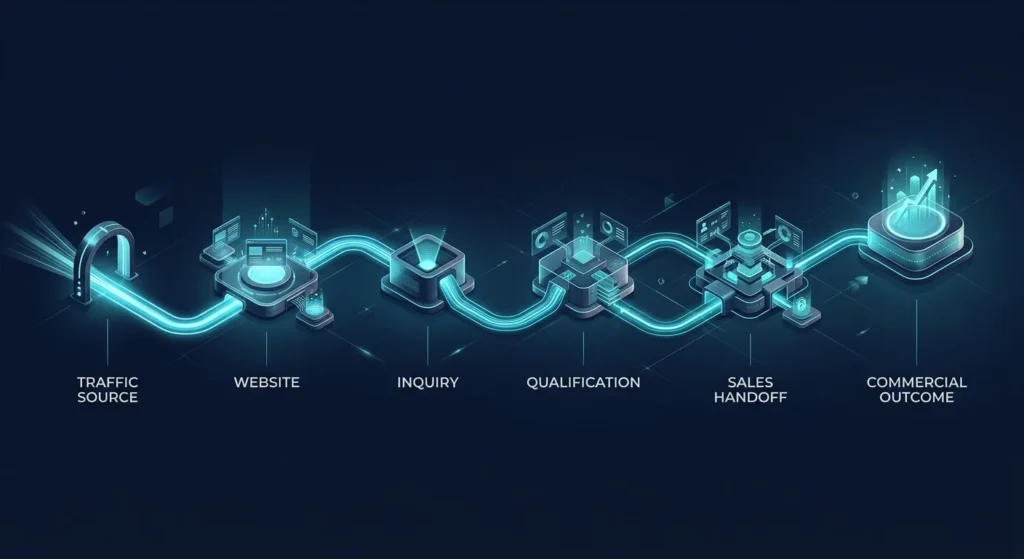
For service businesses, attribution usually requires a longer chain: source, enquiry, qualification, opportunity, closed deal, and revenue. Google Analytics allows businesses to associate values with key events, but the website and CRM still need consistent identifiers and process ownership if final sales happen elsewhere.
This is where revenue per visitor becomes more than a reporting ratio. It can expose whether the weakness sits in acquisition, message fit, conversion, qualification, follow-up, or measurement. Mono’s Website Conversion System focuses on the decision path before the enquiry, while Digital Growth Infrastructure connects source context, CRM ownership, automation, and reporting across the wider operating flow.
A useful measurement system should change priorities. If qualified traffic is strong but value remains weak, inspect the conversion path and offer. If lead quality is poor, review intent matching, qualification, and routing. If strong opportunities fail to become revenue, the problem may sit after the website. If one channel performs well economically but cannot scale efficiently, compare its customer acquisition cost before increasing budget.
The goal is not to replace every marketing KPI. It is to stop treating traffic volume as proof of quality. Revenue per visitor gives decision-makers a clearer bridge between attention and commercial outcome, helping them invest in the part of the website and customer journey that actually limits value.
If traffic is arriving but commercial value varies by source or page, review the journey from landing experience to qualified inquiry before increasing acquisition spend.
Request Conversion ReviewExplore Conversion SystemArticle FAQ
It measures the amount of website-attributed revenue generated relative to the number of visitors in the same measurement period. It is most useful when the visitor definition and attribution method remain consistent.
It answers a different question. Conversion rate measures how frequently visitors complete an action, while revenue-based measurement helps show the economic value produced by those visitors.
Yes. The business needs to connect website enquiries with qualification, sales opportunities, closed deals, and their revenue value through analytics and CRM records.
Usually not. Channel, campaign, landing page, service, geography, and device segments can reveal differences that a sitewide average hides.
Yes. Acquisition cost, margins, sales capacity, deal quality, and scalability still matter. Revenue efficiency should be evaluated alongside cost and profitability.