Necessary
Always activeSupports security, form reliability and remembering your privacy choice. It is not used for advertising.

Website structure connects page roles, visitor decisions, captured context, operational ownership, and measurement into one maintainable journey.

Website structure impact appears in how easily visitors understand an offer, move between decisions, complete an action, and receive a useful response. It also affects how teams classify enquiries, maintain content, and measure outcomes. Structure is therefore a business and operational concern, not simply navigation or visual layout.
A page is one part of a journey. Search intent, message hierarchy, proof, related content, forms, routing, and follow-up all depend on relationships between elements. Mono’s comparison of website systems and disconnected pages explains why isolated improvements often leave the wider constraint intact.
1. Entry pages do not match intent. Organic, paid, referral, and returning visitors arrive with different questions. Poor website structure sends them to generic pages or offers several equal next steps. Map each important entry point to a relevant page role and a commitment appropriate to the visitor’s context.
2. The decision sequence is incomplete. A conversion-focused website moves from relevance to explanation, evidence, risk reduction, and action. Weak conversion flow jumps between claims or asks for contact before building enough confidence. Mono’s conversion psychology principles help identify the questions that should be resolved in order.
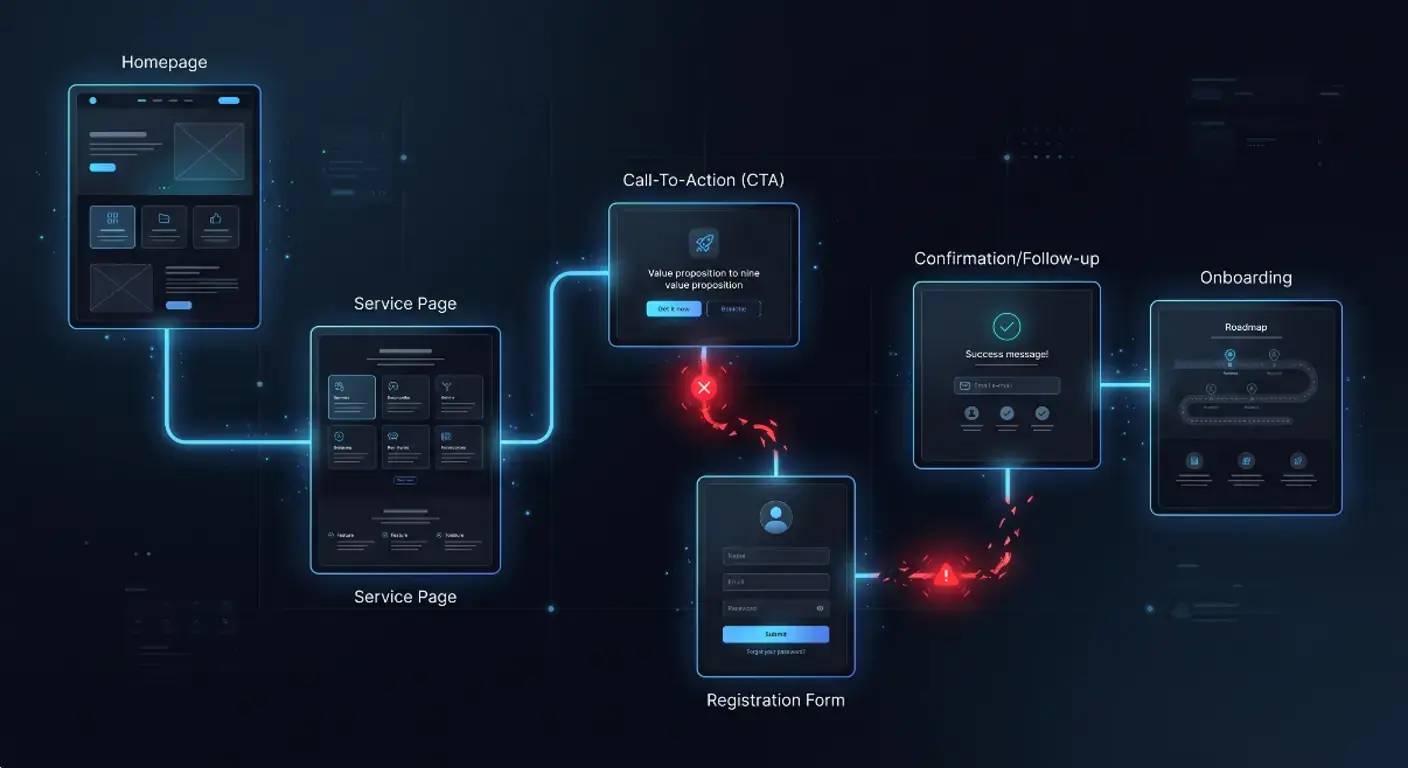
3. Pages compete instead of supporting one another. Service pages, Insights, proof, and contact routes need distinct roles and descriptive internal links. Duplicate or near-duplicate pages divide attention and create maintenance risk. Google’s SEO Starter Guide reinforces organizing a site for users and discovery rather than producing disconnected volume.
4. Forms collect data without creating progress. Ask only for information needed at the next stage, explain its purpose, provide accessible validation, and confirm what happens after submission. Customer handling becomes slower when the team receives vague notifications or must ask for context the visitor already supplied.
5. Handoffs lack ownership. Lead flow automation should acknowledge the request, route it by a clear rule, and create an owned task. CRM integration should preserve source, service interest, consent, and status while handling duplicates and transfer failures. A lead generation website system connects the page journey to that operational responsibility.

6. Automation hides an undefined process. A website automation system can reduce repeated administration, but only after decisions, owners, and exceptions are clear. Use Mono’s automation overview to distinguish useful handoffs from unnecessary complexity.
7. Measurement is separated from outcomes. Page views and form totals cannot show whether the site attracts suitable prospects or supports the team’s response. Connect source, page, action, qualification, ownership, and outcome with consistent definitions. Review the wider Digital Growth Infrastructure context when several platforms must share that operating view.
Choose one priority service and trace the path from entry to resolved outcome. Record the visitor question, page role, evidence, action, data created, destination system, and responsible owner at each stage. Include alternate routes for visitors who need more information and do not force every audience toward the same commitment.
Test mobile use, keyboard navigation, form errors, interrupted connections, unavailable appointments, duplicate submissions, and delayed integrations. Verify that users receive safe recovery guidance and that internal teams see a meaningful exception. A system that works only in the ideal path is not dependable.
Review content governance. Assign owners for service accuracy, proof, internal links, forms, and response promises. Establish when priority pages should be checked and what triggers a review. Structural value decays when outdated claims, orphaned content, or broken destinations accumulate without responsibility.
Measure technical delivery alongside comprehension and action. The pagespeed optimization guide connects loading evidence with the full user journey. Fast delivery protects attention, but it cannot repair unclear positioning, missing proof, or a failed operational handoff.
Combine analytics, search entry pages, form logs, lead quality, response status, and staff interviews. Rank constraints by customer impact, frequency, business consequence, evidence quality, dependency, and implementation risk. Fix broken actions and high-impact decision gaps before decorative refinements.
Document website structure impact at both customer and team levels. A visitor may face uncertainty or a failed action while staff experience repeated questions, manual classification, or inconsistent reports. Recording both perspectives prevents the project from optimizing a visible page while preserving the operational cost behind it.
Protect existing search value during structural work. Keep useful URLs, titles, metadata, and content relationships stable unless evidence and an approved migration plan justify change. Update internal paths deliberately and verify destinations so improved journeys do not create broken discovery routes.
Start with the smallest release that proves the new structure: perhaps one service journey, a clearer evidence sequence, a simpler form, and owned routing. Define a baseline and acceptance criteria, then verify content, action, delivery, and reporting after deployment. Do not infer success from a score change alone.

The Website Conversion System fits existing traffic with a weak decision path, while conversion-focused web development supports a broader build. Website structure impact becomes positive when page roles are coherent, handoffs are owned, and teams can maintain and measure the complete journey.
Review entry points, decision sequence, capture, routing, and measurement as one structure.
Request a System ReviewSee Web DevelopmentArticle FAQ
It includes page roles, message hierarchy, proof, internal relationships, calls to action, forms, data handoffs, response ownership, and outcome measurement.
It can attract or route visitors to generic journeys, capture too little context, and send every request into the same process regardless of intent.
No. A focused repair to one priority journey may clarify page roles, evidence, capture, and routing before a wider rebuild is justified.
Automate stable, repeatable handoffs only after decisions, ownership, exception handling, and data requirements are defined.
Establish a baseline across entry, action, delivery, qualification, response, and outcome, then compare equivalent journeys after verifying the change.