Necessary
Always activeSupports security, form reliability and remembering your privacy choice. It is not used for advertising.

A submitted form is only useful if it reaches a named owner fast enough to matter. Routing is the rule layer that decides who acts, when, and what happens when nobody does.

Most service businesses treat a submitted form as a finished job. The visitor sees a confirmation, the business gets an email, and the opportunity waits in a shared inbox until somebody claims it. Lead routing automation is the layer that removes that wait. It decides, at the moment of submission, who owns the request, where it goes and what happens if nobody acts on it. Routing is not a notification setting; it is a business rule expressed in software, and it determines whether an inquiry you already paid to generate reaches a person who can answer it. Mono’s guide to where enquiries get lost before sales responds shows how quickly responsibility disappears when that layer is missing.
Routing answers three questions the moment intent is captured: who is responsible, how quickly they should act, and what happens if they do not. A shared inbox answers none of them. It distributes visibility without assigning lead ownership, which is why inquiries in busy teams are seen by everyone and owned by no one.
The cost of that gap is well documented. Harvard Business Review research into how quickly online sales leads go cold found that most audited companies were responding to web-generated inquiries far more slowly than the buying window allows. Delay is rarely a motivation problem. It is a design problem: when nobody is named, the reply waits for whoever happens to notice first.
Lead routing automation fails for predictable reasons. The six rules below describe what a dependable route needs before any tool is chosen.
A route can only use data the form actually collects. If service type, location, language or urgency is never requested, every submission looks identical and sorting stays manual. Decide the routing rules first, then design the request around them, adding only fields that change a decision. Mono’s guide to reducing form drop-off without lowering lead quality covers that balance directly: every extra field costs completion, so it should earn its place by changing where the inquiry goes or how fast it is handled.
Before anything is configured, the logic should read as sentences a manager would recognise. Inquiries for one service go to one owner. Requests above a defined value go to a senior consultant. A second language goes to the team that can answer in it. Written this way, gaps and overlaps surface before they reach production. This is also where lead qualification belongs, because the rule set defines what a useful opportunity looks like rather than only where it lands. Mono’s analysis of why more enquiries don’t always mean more revenue explains why sorting by fit matters more than sorting by volume.
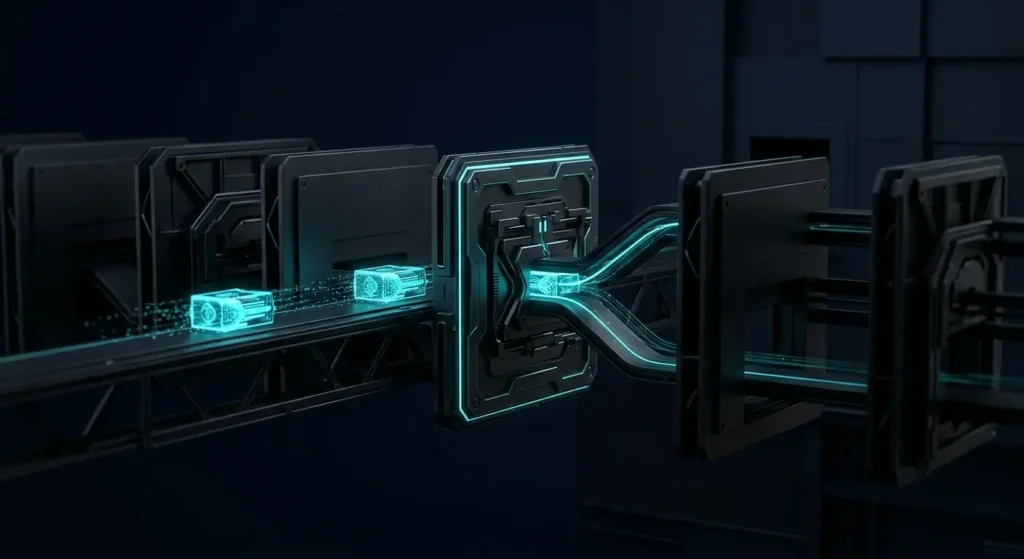
Every route should end at a named person, or at a queue with a defined on-duty owner. Shared responsibility is the most common reason a correctly routed request still goes unanswered. Clear lead ownership also makes the sales handoff auditable: the record shows who received the inquiry, when it arrived and what context came with it. Mono’s Lead Generation System treats source, capture, qualification, routing and response as one connected path, which is what makes accountability visible instead of assumed.

Rules only cover the cases you predicted. Something has to catch requests that match no rule, arrive outside working hours, or sit untouched past an agreed threshold. A default owner, a timed escalation and an alert when a workflow fails are what stop lead response time from depending on who happens to be online. Where intake questions repeat, AI Automation can acknowledge the request, collect missing context and pass a summarised inquiry to a human instead of leaving the visitor in silence.
Most service businesses collect intent from several places: website forms, WhatsApp, phone calls, booking pages and campaign landing pages. When only the website form is routed, every other channel quietly becomes the slow path. The same rules should apply wherever a request arrives, which usually means channels share one record rather than one inbox. Mono’s AI Customer Response System applies the same lead qualification and handoff logic to live conversations, and connecting the website to other business systems is what allows a single route to span several tools.
A submission count proves nothing about routing. Useful measurement records whether an owner was assigned, whether a first reply happened and whether the request progressed. Google documents recommended events covering the lead lifecycle, including stages well beyond the initial submission, which makes downstream conversion tracking practical rather than theoretical. Dependable CRM integration matters here too, because a record created by hand produces timestamps that are guesses. Mono’s guide to processes your site should handle automatically covers the failure paths that keep silent breakages visible.
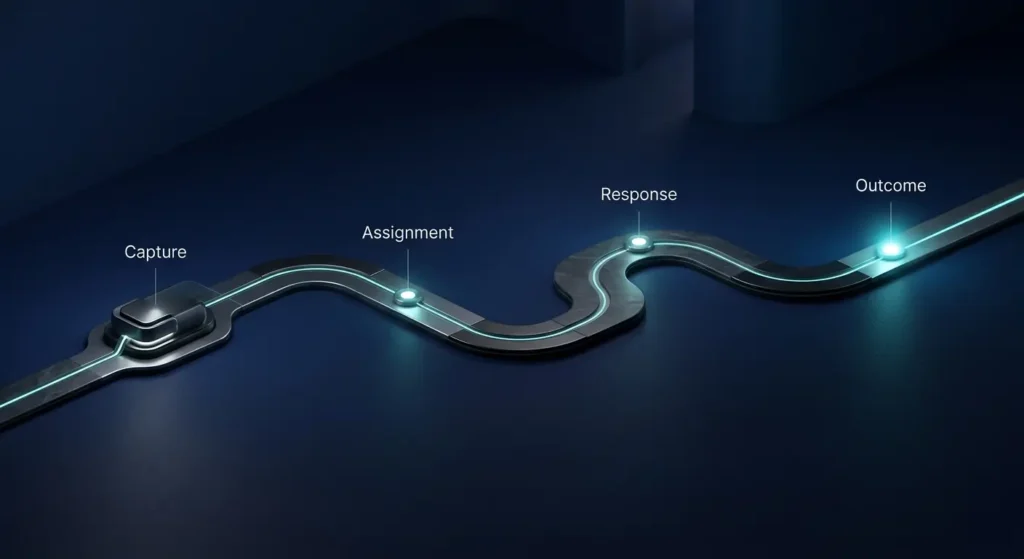
The fastest way to make lead routing automation useful is to stop designing the whole system and route one thing properly. Choose the highest-value inquiry type, write its rule as a sentence, name its owner, define its fallback, and confirm each step is visible from submission to first reply. Trace one real request through it end to end before adding a second route.
Scaling then becomes an operational question rather than a technical one, because every new rule inherits a structure that already works. What should happen in the seconds after the click is covered in more depth in Mono’s guide to what happens after a lead clicks submit. When several tools, teams or services are involved, a System Review is usually the shortest way to identify which route to fix first.
Send one real inquiry through your current setup and you usually find the gap within minutes — an unnamed owner, an unrouted channel, or a notification nobody can prove arrived. Mono will map the path from submission to first reply and recommend the smallest change that makes ownership visible.
Explore Lead SystemGet System ReviewArticle FAQ
A notification tells people something arrived. Routing decides who is responsible for it. A business can send perfect notifications to a shared inbox and still have no one accountable for the reply.
No. A spreadsheet, a task tool or a messaging channel with defined owners can work at low volume. What matters is that the assignment is recorded, timestamped and visible — not which product holds it.
Service type is usually the highest-value criterion, followed by language, location, and deal size or urgency where the sales process actually treats those differently. Add a criterion only when it changes who acts or how quickly.
Acknowledge immediately with a message that sets an honest expectation, then queue the request for the next available owner with a defined escalation window. The failure mode to avoid is silence, not slowness.
Whenever the service list, team structure, languages or main traffic sources change. Rules written for a three-person team frequently misfire once a second service line or region is added.