Necessary
Always activeSupports security, form reliability and remembering your privacy choice. It is not used for advertising.

A submitted form is not the same as a sales opportunity. Diagnose the seven handoff gaps that can lose enquiry context, ownership and momentum before your team responds.
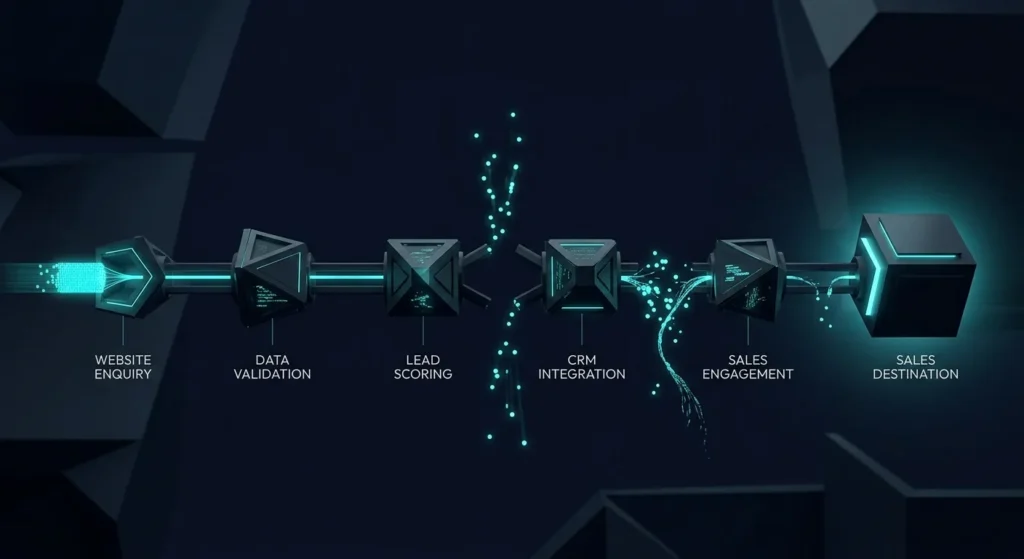
A website enquiry can be submitted successfully and still never become a usable sales opportunity. Website lead leakage happens when intent is captured but context, ownership, notification, or follow-up breaks before sales can act. The form may work; the failure sits in the handoff behind it.
That distinction matters because adding more traffic does not repair an unreliable lead path. Mono’s Website Structure Impact guide makes the broader point: website structure affects customer handling as well as the page experience. A diagnostic review should follow the enquiry from submission to the person responsible for responding.
A name, email address, and message box may technically create a lead, but they can leave sales guessing about service interest, urgency, location, or project type. Weak lead qualification pushes basic discovery into the first reply and complicates prioritisation.
Review what sales genuinely needs to decide the next action, then collect only that context. Mono’s website conversion audit treats form friction and qualification as one decision: enough information for a useful handoff without turning first contact into a long application.
When campaign, landing-page, service, or referral context is lost, every enquiry looks identical. Marketing can report submissions, but sales cannot easily judge what promise brought the prospect in or whether a particular source is producing relevant opportunities.
Preserve source and page context with the record. Google Analytics also defines generate_lead, qualify_lead, and related recommended lead-generation events, showing why measurement should extend beyond a raw form count.
One of the clearest forms of website lead leakage is an enquiry that reaches the business but has no explicit owner. Shared inboxes can work at low volume, yet responsibility becomes ambiguous across services, locations, languages, or sales roles.
Good lead routing sends the request and its context to the correct owner or queue. Mono’s Lead Generation System is structured around this source-to-response path: capture, qualification, routing, ownership, response, and measurement are treated as one system rather than separate tools.

A form success screen proves only that the visitor reached a confirmation state. It does not prove that an email arrived, a CRM record was created, a webhook completed, or a salesperson saw the request.
This is where CRM integration and workflow monitoring need operational checks. Critical steps need a visible success state, failure handling, and a fallback route. Mono’s guide to website workflow automation expands this principle with routing, record creation, confirmations, and exception handling.

Lead handling does not require instant human availability, but the prospect should not enter a silent gap after acting. Clear confirmation can explain what happens next, while internal notifications make the next task visible.
Improving lead response time begins by removing avoidable delay rather than promising unrealistic speed. For businesses with repeated intake questions, AI Automation can support controlled qualification, summaries, alerts, and human handoff where the workflow is stable enough to automate.
Even when a request reaches the right person, useful details may be buried in an email thread, copied manually into a spreadsheet, or separated from the original page and campaign context. That creates rework and increases the chance that important information is missed.
A stronger sales handoff gives sales a consistent record: contact details, requested service, source, lead qualification context, timestamp, owner, and next action. It is a downstream version of the silent conversion leaks that often remain invisible in normal page reporting.
A dashboard that counts forms cannot reveal whether leads were routed correctly, contacted, qualified, or progressed. Conversion tracking should connect the customer-facing action with downstream lead states wherever the business can measure them reliably.
Start with a small set of checkpoints: submission recorded, owner assigned, first action visible, qualification status updated, and outcome captured. Mono’s Digital Growth Infrastructure is relevant when those checkpoints span several tools and need one connected operating layer.
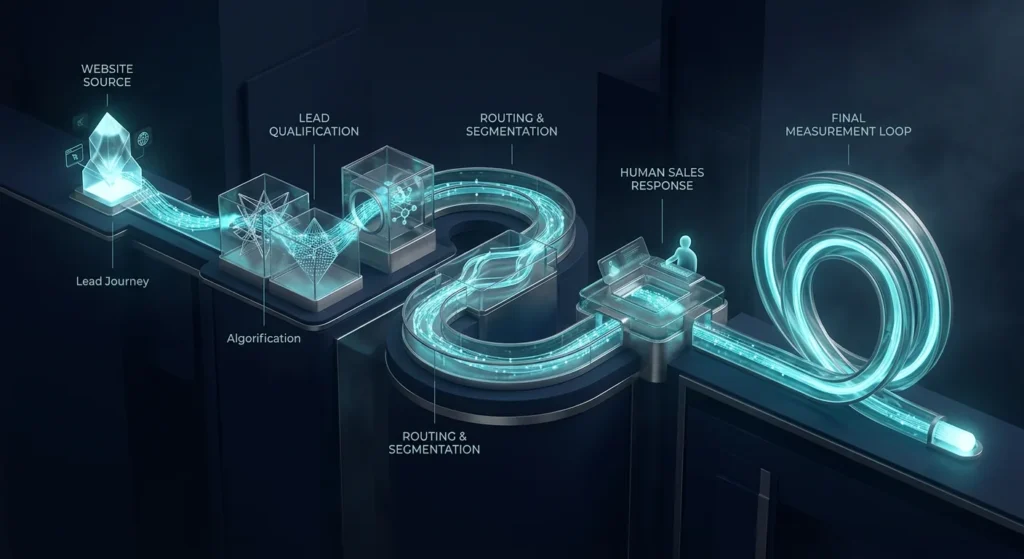
The practical question is not only “Did the form work?” It is “Can we trace a real enquiry from the visitor’s action to a clear sales owner without losing context?”
Map one recent lead end to end. Check the page it came from, fields captured, source data, confirmation, notification, record creation, owner, response step, and measurable status. If any stage depends on memory, copy-paste, or an invisible notification, it is a leakage point.
Fixing website lead leakage means making that path observable and owned. Once the handoff is reliable, traffic, conversion work, automation, and sales effort reinforce the same system instead of compensating for gaps between them.
Map the path from traffic and form submission to qualification, ownership, response and measurement. A connected lead system makes each useful enquiry visible and gives the team a clear next action.
Explore Lead SystemGet System ReviewArticle FAQ
Lead leakage occurs when genuine customer intent is lost somewhere between capture and sales action. The form may submit correctly while source data, qualification context, notifications, ownership, or follow-up fails.
Trace several real enquiries from their originating page through form submission, confirmation, internal notification, CRM or record creation, ownership and first sales action. Any stage that cannot be verified is a potential leakage point.
Not necessarily. Existing websites can often be improved by changing forms, tracking, routing, notifications, CRM connections and response workflows without rebuilding the complete frontend. Mono’s current Lead Generation System explicitly supports improving an existing website or adding a focused lead path.
Not always. The correct destination depends on the business workflow and available tools. A CRM may be appropriate for structured sales processes, while smaller workflows may use another controlled record system. The important requirement is preserving context and ownership.
Useful checkpoints include successful submission, source context, qualification status, assigned owner, response state and eventual lead outcome. Google Analytics currently provides recommended events covering several stages of the lead lifecycle.