Necessary
Always activeSupports security, form reliability and remembering your privacy choice. It is not used for advertising.

Website projects fail early when audiences, conversion paths, content responsibilities, technical dependencies, and success measures are not defined before design begins.

Website strategy planning determines whether a website becomes useful business infrastructure or an expensive collection of pages. Projects often appear to begin with design, but the decisive work happens earlier: defining audiences, business outcomes, conversion paths, content responsibilities, technical dependencies, and how the team will measure success.
When those decisions are missing, teams fill the gaps with assumptions. Designers interpret vague goals, developers build around incomplete requirements, and stakeholders introduce new priorities after production begins. The resulting website project failure is usually blamed on execution even though the underlying problem was never resolved before execution started.
A useful strategy is not a page checklist. It explains who the website serves, what visitors need to understand, which actions matter, what information must be captured, and what happens after each conversion. This is why a website needs an operating system behind it, not merely attractive templates.
Good planning also establishes constraints. Budget, deadlines, integrations, compliance needs, editorial capacity, and internal approvals all shape the solution. Documented project requirements give the team a shared basis for decisions and make scope changes visible before they quietly consume time.

User journey mapping shows how different visitors move from an initial question to a confident next step. It exposes what information belongs at each stage, where trust must be established, and where users need reassurance or proof. Without that map, navigation reflects internal company structure rather than customer intent.
The journey should lead into a defined conversion funnel. Awareness pages create context, service pages establish fit, evidence reduces uncertainty, and forms or booking steps capture the right information. The W3C guidance for accessible forms reinforces that labels, instructions, validation, and feedback must be designed as part of the interaction—not added after launch.
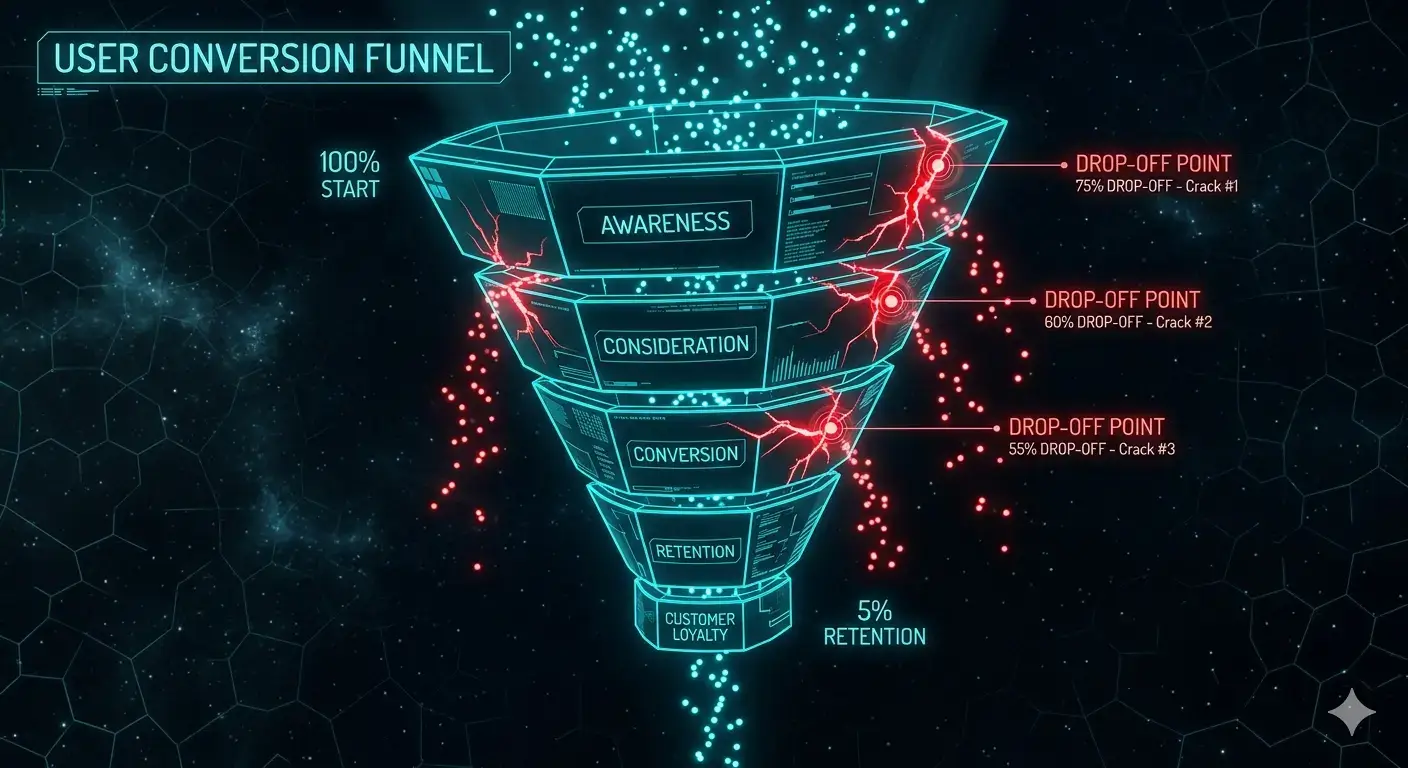
Content planning should begin with decisions the reader must make. A coherent website structure strategy groups related questions, creates clear pathways, and gives every page a defined role. Descriptive, crawlable links also help visitors and search systems understand relationships, as explained in Google Search Central’s link guidance.
This work connects directly to business website strategy. The site must support marketing, sales, service delivery, and measurement rather than treating each page as an isolated publishing task. Relevant business website systems clarify how lead capture, routing, automation, and reporting fit together.
Website system design translates strategy into architecture. It identifies content types, integrations, data ownership, form destinations, automation rules, permissions, and measurement events. This gives web development a stable implementation target and prevents technology choices from controlling the strategy.
Teams should test the model before committing to detailed design. Review representative visitor scenarios, confirm every important action has an owner, and identify where information crosses tools or departments. A focused website audit can reveal missing assumptions, while conversion-leak analysis shows where weak transitions could reduce results.
A planning document should identify who approves content, who owns form responses, who maintains integrations, and who reviews performance after launch. These responsibilities often cross marketing, sales, operations, and technical teams. Naming owners early prevents important decisions from being deferred until the website is already in production. It also gives suppliers and internal contributors a clear escalation path when requirements conflict or information is missing.
Measurement deserves the same precision. Teams should agree on which events indicate useful progress, how qualified inquiries are distinguished from general activity, and where source information is retained. A lead generation website system is easier to evaluate when the reporting model is defined before forms, analytics, and customer records are connected. Otherwise, teams may launch with dashboards that show traffic but cannot explain which paths create meaningful opportunities.

Effective website strategy planning ends with decisions the delivery team can use. The strategy should define audiences, page purposes, content owners, conversion events, integrations, acceptance criteria, and measurement responsibilities. It should also record unresolved risks so they are managed deliberately rather than discovered during development.
That clarity does not remove change; it makes change manageable. When new information appears, the team can evaluate it against agreed goals instead of redesigning by instinct. Teams can also sequence delivery around dependencies, test uncertain assumptions early, and protect essential outcomes when time or budget changes. This is the foundation behind strategic website design and a dependable website conversion system.
Without website strategy planning, projects accumulate uncertainty until rework becomes inevitable. With it, design and development become coordinated implementation stages, and the website has a realistic path to supporting growth after launch. This creates a practical basis for accountable delivery.
Clarify the journey, conversion logic, technical requirements, and ownership model before design and development begin.
Start a System ReviewSee Web DevelopmentArticle FAQ
Define the target audiences, business outcomes, visitor journeys, page purposes, conversion events, content ownership, integrations, and success measures before detailed design.
They often begin with vague goals, incomplete requirements, unclear ownership, and no agreed conversion or measurement model, causing assumptions and rework later.
No. A sitemap organizes pages, but a complete strategy also explains audience intent, content responsibilities, conversion paths, technical dependencies, and operational follow-up.
Planning makes scope, assumptions, dependencies, ownership, and acceptance criteria visible, allowing teams to resolve conflicts before they become expensive implementation changes.
It can evolve when evidence changes, but updates should be evaluated against documented business goals and user needs rather than introduced as disconnected preferences.