Necessary
Always activeSupports security, form reliability and remembering your privacy choice. It is not used for advertising.

Turn inconsistent inquiries into a reviewable intake flow: collect essential context, apply explicit qualification rules and give a person the information needed to follow up.
Routing decisions are scoped with the business owner. Consent, missing details and human escalation are design constraints—not optional afterthoughts.
Decision map is illustrative · No live leads, scoring values, response times or bot uptime shown
For B2B service teams, consultative sales and high-consideration requests where a generic autoresponder is not enough.
Ask for relevant service needs, time frame and business context with clear data-use expectations.
Set transparent categories and follow-up rules. Require human review for ambiguity or high-impact decisions.
Assign an owner, carry forward the conversation summary and preserve a route for exceptions.
Lead data can be incomplete, sensitive or inaccurate. We define explainable criteria and escalation paths so uncertain inquiries are not silently rejected or routed incorrectly.
Marketing attribution, CRM permissions, retention and customer communication all require owner approval and compatible tools.
Collect only necessary information, document lawful collection and respect the client's applicable consent and retention rules.
Agree priority signals, named follow-up owners, overrides and when the flow must seek clarification.
Check field mappings, duplicate handling, access scope and what happens when a destination is unavailable.
The proposal separates intake implementation, rules, CRM integration and ongoing operational ownership.
Use representative real-world cases, anonymized wherever practical, including cases that do not match the normal flow.
List inquiry sources, missing details, CRM fields and follow-up owners.
Define qualification, consent boundaries, routing and escalation.
Check ordinary, duplicate, invalid and ambiguous test inquiries.
Document monitoring, ownership and required approval for expansion.
Case studies appear only from existing published projects; no simulated qualification metrics are presented.
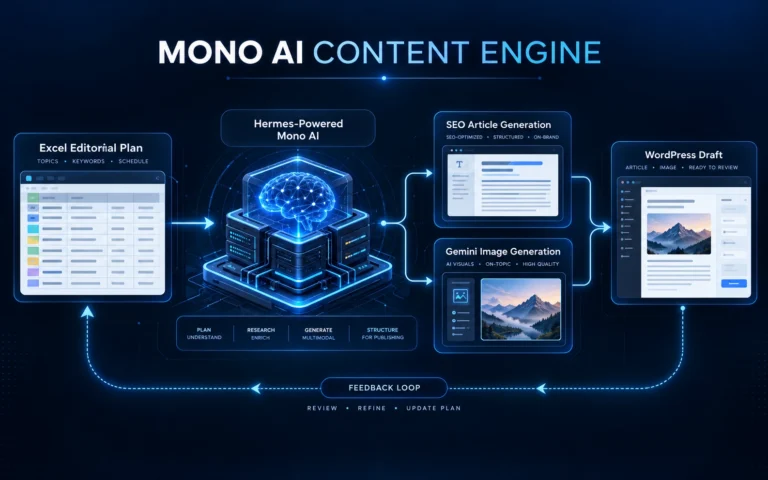
Mono built a Hermes-powered SEO content engine that turns structured editorial plans into daily WordPress drafts, supporting visuals, and renewable publishing queues.
OutcomeEstablished a repeatable daily SEO content workflow connecting editorial planning, AI-generated articles and visuals, WordPress drafts, and content-cycle renewal.
View Case StudyMono built an AI-assisted WordPress workflow that prepares localized, SEO-validated drafts across five languages through on-demand and twice-daily scheduled automation.
OutcomeEstablished on-demand and twice-daily automated workflows for preparing validated WordPress drafts in five target languages, with editorial review retained.
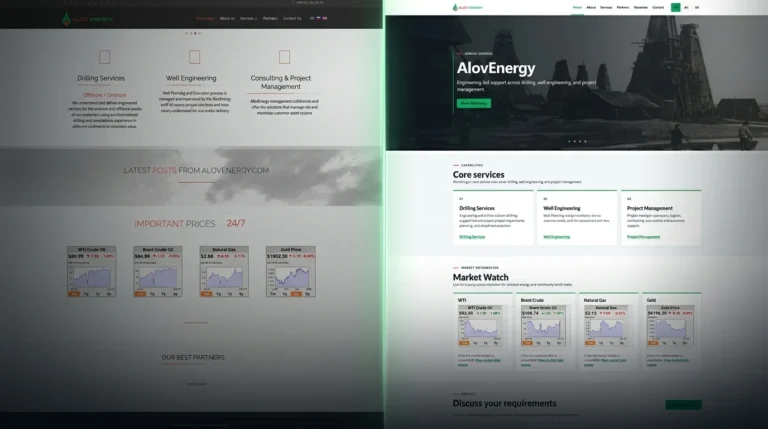
View Case StudyAlovEnergy's outdated Joomla website was rebuilt in WordPress with a lighter architecture, three language versions, clearer service pages, and markedly improved Lighthouse performance.
OutcomeA responsive, three-language WordPress website replaced the legacy Joomla build; the homepage achieved 100 Performance scores in subsequent mobile and desktop Lighthouse tests.
View Case StudyHelpful details
Practical answers before requesting a scope.
Default designs use explainable triage signals and human review for uncertain or sensitive decisions. Any automatic exclusion must be explicitly approved, appropriate and tested.
A scoped integration may be possible after checking available APIs, permissions, field mappings, rate limits and error recovery. Compatibility is not assumed.
This page does not promise availability or unattended messaging. Messaging channels, permissions, consent and approved follow-up windows are agreed per integration.
The workflow defines fallback review, de-duplication rules and an accountable human owner so unclear cases are not silently lost.
Lead operations / Pilot first
Tell us where inquiries arrive, what a suitable lead looks like, which CRM you use and who makes final follow-up decisions.
Scope and next steps are agreed before implementation.