Necessary
Always activeSupports security, form reliability and remembering your privacy choice. It is not used for advertising.

Design practical AI-assisted workflows for content, incoming leads and everyday operations—without treating an algorithm as the final decision-maker.
We agree on data access, approval rules, exceptions and a pilot scope before any live-system changes.
Start with the repeated task and the person who owns the outcome—not with an AI feature list.
Move from a content brief to an editable draft, with editorial approval before anything goes public.
Best fit Teams managing recurring content, localization and WordPress editorial work.
Structure incoming inquiries, recognize missing details and hand qualified cases to a real person.
Best fit Teams losing time to manual lead sorting and inconsistent follow-up.
Connect well-defined repetitive tasks across systems with reliable status and recovery paths.
Best fit Operations with repeatable steps, compatible tools and an accountable process owner.
A useful workflow knows which inputs can be trusted, what it can propose, where a human must step in and how an exception is handled. Sensitive or irreversible actions require explicit permissions and sign-off.
Explore our AI Automation capabilityEvery implementation is scoped to your systems, approved access and real operational constraints.
Walk through the current task, handoffs and recurring exceptions with its owner.
Confirm data, permissions, acceptance criteria and mandatory human gates.
Run representative scenarios, inspect outputs and fix failure paths before wider use.
Assess usefulness and maintenance needs; expand only if the evidence supports it.
Tasks with unclear ownership, unreliable source data or decisions that cannot be safely reviewed may need process improvement before AI. We will recommend a simpler rule-based integration—or no automation—when it is the better fit.
Third-party model usage, recurring costs, availability and data processing terms are assessed per provider and scope; they are not implied inclusions.
Published project examples are context for delivery methods, not proof of AI deployment or guaranteed output.
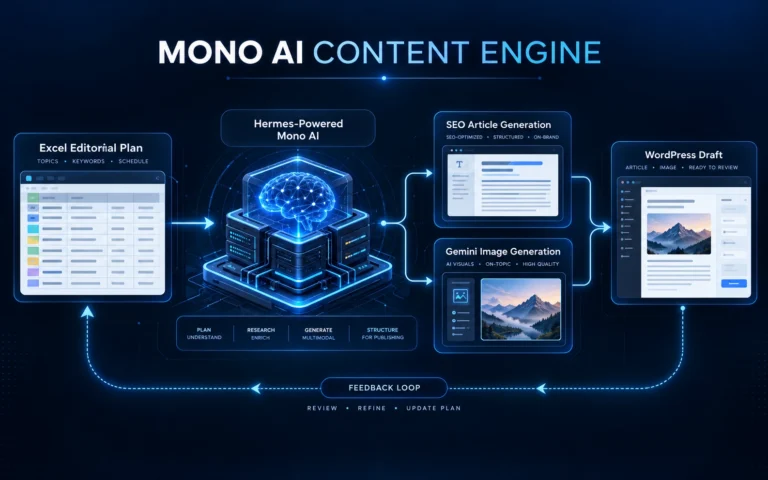
Mono built a Hermes-powered SEO content engine that turns structured editorial plans into daily WordPress drafts, supporting visuals, and renewable publishing queues.
OutcomeEstablished a repeatable daily SEO content workflow connecting editorial planning, AI-generated articles and visuals, WordPress drafts, and content-cycle renewal.
View Case StudyMono built an AI-assisted WordPress workflow that prepares localized, SEO-validated drafts across five languages through on-demand and twice-daily scheduled automation.
OutcomeEstablished on-demand and twice-daily automated workflows for preparing validated WordPress drafts in five target languages, with editorial review retained.
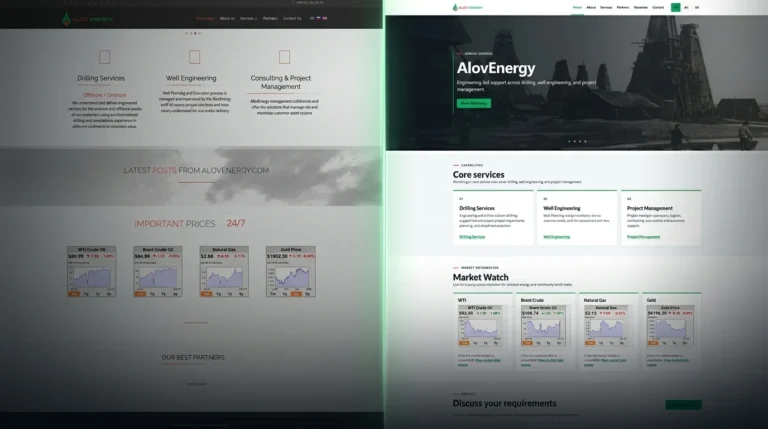
View Case StudyAlovEnergy's outdated Joomla website was rebuilt in WordPress with a lighter architecture, three language versions, clearer service pages, and markedly improved Lighthouse performance.
OutcomeA responsive, three-language WordPress website replaced the legacy Joomla build; the homepage achieved 100 Performance scores in subsequent mobile and desktop Lighthouse tests.
View Case StudyHelpful details
Practical answers before requesting a scope.
Not by default. We map publishing and outbound communication approvals during scope, with draft-first and human review paths where appropriate.
Potentially. Feasibility depends on available APIs, account permissions, data quality, licensing and how safely the system can be tested.
We plan validation, explicit human review, failure logs and exception routing. Model-generated content or classifications are not assumed to be correct.
No. A limited pilot on a repeatable, low-risk task can establish the requirements and help decide whether wider automation makes sense.
Start with the workflow
Describe the task, systems it touches, who checks the result and what must never happen automatically. We will discuss whether a controlled pilot is appropriate.
Scope and next steps are agreed before implementation.