Necessary
Always activeSupports security, form reliability and remembering your privacy choice. It is not used for advertising.

Replace fragile manual handoffs with a documented process across your existing systems. Make permissions, approvals and recovery paths part of the workflow from the first diagram.
Integration feasibility depends on system APIs, data access, process stability and owner approval. Sensitive actions remain human-controlled unless explicitly authorized.
Concept architecture · No real transactions, system status or execution counters
Start with a process that has stable inputs, defined owners and measurable acceptance criteria—not an undefined promise to automate the business.
Move approved requests between teams or tools while preserving a clear owner and completion status.
Validate and transfer agreed fields across compatible systems, with duplicate detection and controlled retry rules.
Keep repeatable reviews, reminders and decisions visible without automating high-impact approvals.
Operational systems fail in messy ways: missing fields, expired credentials, duplicate events, permission changes or upstream outages. An automation should expose those cases and make recovery possible.
Each workflow receives a business owner, a supported action boundary, review conditions and an operational handoff—not a perpetual unattended promise.
Identify service accounts, credential ownership, approved scopes and the systems permitted to change data.
Define validation failures, duplicate suppression, retries and manual overrides before deployment.
Record agreed actions, decision points and failures according to scoped logging and retention requirements.
Automation scope is confirmed after checking access, vendor APIs, data classifications and exception rates.
The first milestone is a shared process definition, not an invisible background agent.
Record tasks, actors, systems, bottlenecks and data sensitivity.
Specify validation, permissions, approval and exception routes.
Verify normal, duplicate, invalid and downstream-failure cases.
Document operation, monitoring responsibilities and expansion gates.
Only current published Work entries are displayed; diagrams above are conceptual, not customer performance reports.
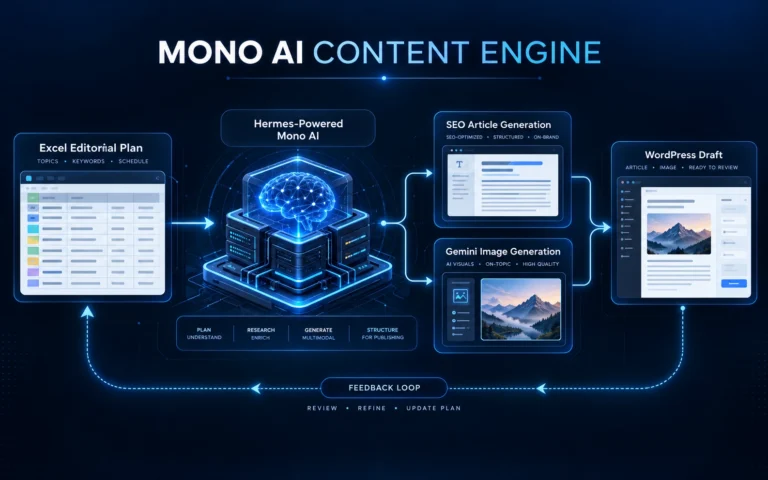
Mono built a Hermes-powered SEO content engine that turns structured editorial plans into daily WordPress drafts, supporting visuals, and renewable publishing queues.
OutcomeEstablished a repeatable daily SEO content workflow connecting editorial planning, AI-generated articles and visuals, WordPress drafts, and content-cycle renewal.
View Case StudyMono built an AI-assisted WordPress workflow that prepares localized, SEO-validated drafts across five languages through on-demand and twice-daily scheduled automation.
OutcomeEstablished on-demand and twice-daily automated workflows for preparing validated WordPress drafts in five target languages, with editorial review retained.
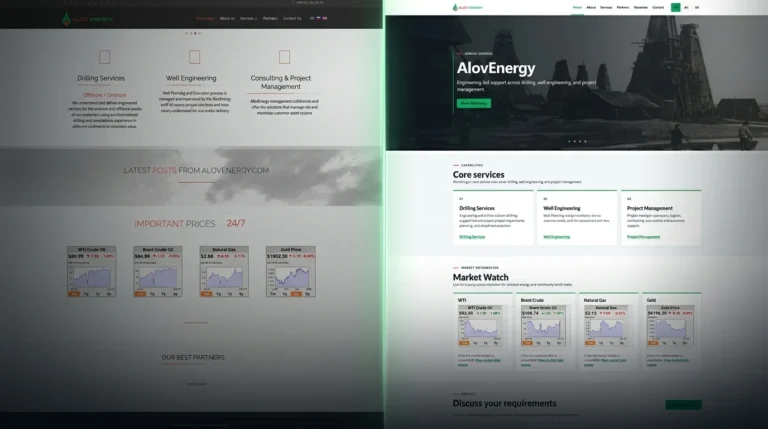
View Case StudyAlovEnergy's outdated Joomla website was rebuilt in WordPress with a lighter architecture, three language versions, clearer service pages, and markedly improved Lighthouse performance.
OutcomeA responsive, three-language WordPress website replaced the legacy Joomla build; the homepage achieved 100 Performance scores in subsequent mobile and desktop Lighthouse tests.
View Case StudyHelpful details
Practical answers before requesting a scope.
We scope specific stable processes and their technical dependencies. A pilot validates fit; it is not a commitment to automate every operation.
Not necessarily. We review existing tools and API permissions first. New licensing or infrastructure is only proposed when needed and approved.
The design defines validation, logging, approved retry limits and a human escalation path. It cannot guarantee third-party services will never fail.
Sensitive actions require documented permissions, risk review and explicit human-controlled approval where appropriate. No such capability is promised by this page alone.
Operational workflow / Assessment
Describe the task you repeat, tools involved, who approves changes and how exceptions are handled today. We will map a realistic starting workflow.
Scope and next steps are agreed before implementation.