Necessary
Always activeSupports security, form reliability and remembering your privacy choice. It is not used for advertising.

When spreadsheets, disconnected tools or a conventional website cannot support the process, build a focused application with the right users, data, access rules and integrations.
Discovery and security boundaries precede architecture decisions. Technology and delivery milestones are proposed after requirements review.
*Integrations depend on vendor access and API feasibility. Diagram does not imply built integrations.
These are representative use cases, not pre-built products or promised feature bundles.
Authenticated views, shared information, task states and role-based access.
Replace fragile manual handoffs with structured requests, approvals and activity histories.
Plan a specific user problem, core workflows and maintainable product boundaries.
A useful technical proposal states what users do, what data moves, what systems connect and what failure means.
Users, roles, authorization boundaries and review ownership.
Core journeys, data changes, approval points and exception handling.
System owners, API availability, provider terms and fallback procedures.
Acceptance scenarios, data migration assumptions and operational handover.
Work is organized into reviewable requirements and agreed milestones. Authentication, data, hosting and maintenance must have explicit owners.
Architecture follows defined requirements, and integrations are validated against the actual provider environment.
Make the priority users, tasks, data and risks explicit.
Agree on screens, APIs, acceptance cases and out-of-scope requests.
Build in milestones with security controls, error paths and stakeholder review.
Document configurations, operating responsibilities and next-phase options.
Real Work entries illustrate approach and execution, not application features or results promised for your project.
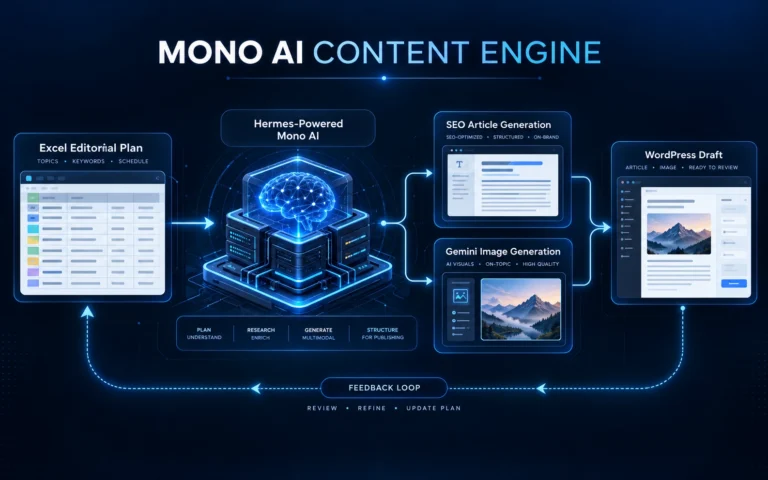
Mono built a Hermes-powered SEO content engine that turns structured editorial plans into daily WordPress drafts, supporting visuals, and renewable publishing queues.
OutcomeEstablished a repeatable daily SEO content workflow connecting editorial planning, AI-generated articles and visuals, WordPress drafts, and content-cycle renewal.
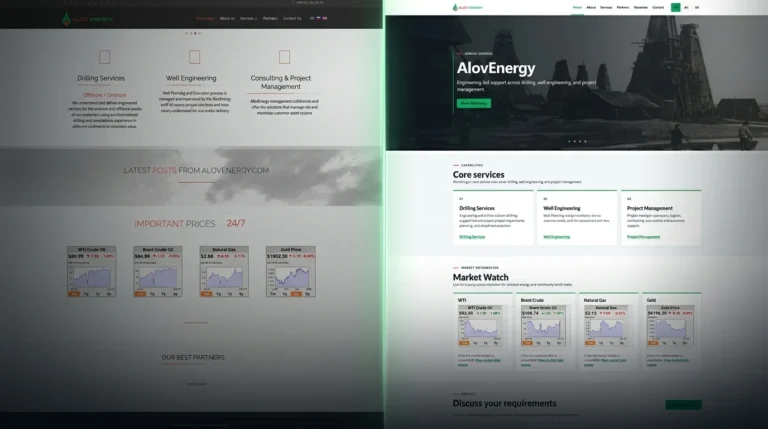
View Case StudyAlovEnergy's outdated Joomla website was rebuilt in WordPress with a lighter architecture, three language versions, clearer service pages, and markedly improved Lighthouse performance.
OutcomeA responsive, three-language WordPress website replaced the legacy Joomla build; the homepage achieved 100 Performance scores in subsequent mobile and desktop Lighthouse tests.
View Case StudyMono built an AI-assisted WordPress workflow that prepares localized, SEO-validated drafts across five languages through on-demand and twice-daily scheduled automation.
OutcomeEstablished on-demand and twice-daily automated workflows for preparing validated WordPress drafts in five target languages, with editorial review retained.
View Case StudyHelpful details
Practical answers before requesting a scope.
We start with workflow complexity, integration needs, team constraints, security and ongoing ownership. Stack choices are proposed after discovery, not assumed from the landing page.
Potentially. We must confirm API access, authentication requirements, rate limits, provider terms and data policies before promising an integration.
Yes if the existing code, access permissions and technical condition are suitable. An audit determines whether extending, replacing or isolating features is safer.
Ownership and operational coverage are defined in the project agreement. Ongoing hosting, monitoring and support require explicitly agreed responsibilities.
Start with the process
Describe the users, repeated tasks, data sources and existing software. We will help shape a reviewable first scope.
Scope and next steps are agreed before implementation.