Necessary
Always activeSupports security, form reliability and remembering your privacy choice. It is not used for advertising.

Website speed shapes trust and revenue across the full customer journey, so performance work should connect technical evidence to high-value actions and business outcomes.
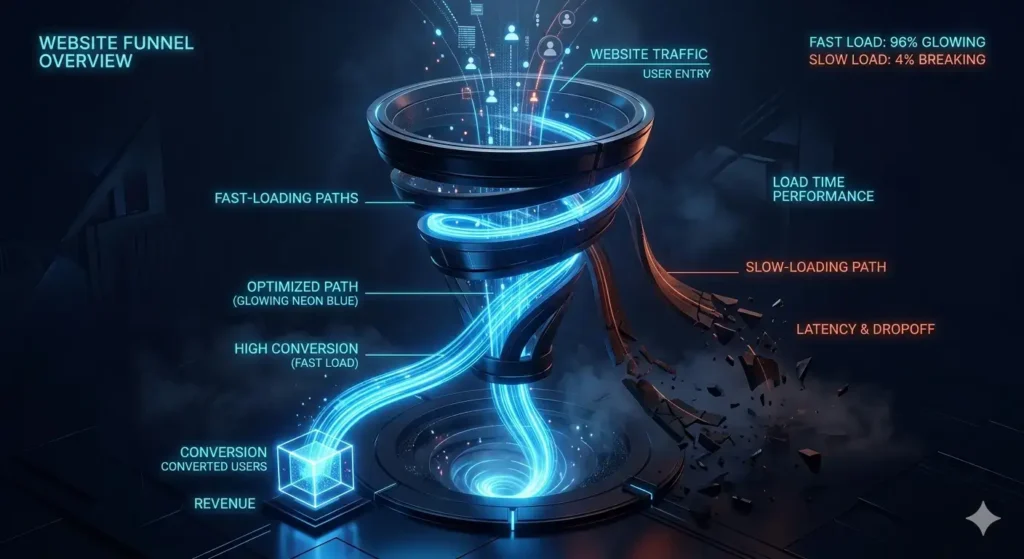
The website speed revenue impact begins before a visitor submits a form or reaches checkout. Delay interrupts attention, makes the interface feel less dependable, and weakens the path from interest to action. That is why slow website performance across the customer journey deserves commercial scrutiny, not just a technical score. The relationship between website speed and conversions is best understood as continuity: every page, interaction, and response must arrive while the visitor still has intent.
Revenue does not disappear only at the payment screen. A slow landing page can prevent visitors from understanding the offer. Delayed navigation can stop comparison between services. A hesitant form can create uncertainty after a prospect has decided to enquire. A structured conversion rate diagnosis therefore examines the whole decision sequence rather than treating the final conversion rate as one isolated number.
The slow website impact on revenue also depends on context. A brief interruption near a low-intent article is different from the same interruption on a pricing, booking, or checkout step. Teams should identify high-value journeys, then compare entry, progression, CTA interaction, form starts, successful submissions, and qualified outcomes. This reveals where performance friction overlaps with business intent.

A useful performance review combines lab diagnostics, field evidence, and direct journey testing. Google explains that PageSpeed Insights uses both simulated lab data and real-user data. Its report can reveal loading, responsiveness, and layout problems, but it cannot decide which page or action matters most to the business. That decision requires analytics context and observation of representative devices, networks, templates, and user paths.
The page speed conversion rate relationship should therefore be tested with a baseline. Record performance and journey outcomes before changing caching, media, scripts, hosting, or templates. Then verify the same pages and actions after each repair. This prevents a better test score from being mistaken for a better customer experience when forms, navigation, tracking, or confirmation states remain unreliable.
Google’s Core Web Vitals guidance separates loading performance, interaction responsiveness, and visual stability. Mono’s practical overview of what Core Web Vitals mean for business websites connects those signals to the moments visitors actually experience. Together, they provide a stronger diagnostic frame than pursuing one headline score.

Visitors do not separate engineering quality from business credibility. They experience whether content appears predictably, buttons respond, layouts remain stable, and forms acknowledge input. This is the practical meaning of website loading speed UX: performance shapes how safe and understandable the interface feels. Mono’s framework for structural website trust signals shows why responsive behaviour belongs alongside clear messaging, proof, security, and risk reduction.
Common website performance issues include slow server response, oversized media, render-blocking resources, sitewide plugin assets, excessive third-party scripts, database delays, and unstable layouts. Yet a symptom does not identify its cause. The same slow page could require a hosting change, a query repair, a template adjustment, or stricter script loading. A broader guide to where performance faults accumulate helps teams investigate the delivery chain instead of installing another optimization tool by default.
Effective website performance optimization follows evidence. Start with representative high-value pages, reproduce the issue, isolate the responsible layer, make the smallest safe change, and retest the complete journey. The deeper explanation of structural performance causes and repair sequencing is useful when live websites have accumulated plugins, campaign tags, media, and integrations over time.
Architecture matters because performance is rarely owned by one component. Templates, content practices, third-party tools, hosting, and measurement all share the same delivery budget. A connected website system architecture gives teams clearer ownership: who approves new scripts, which templates have performance budgets, how releases are tested, and where regressions become visible.
Performance becomes especially costly near commitment. A visitor may tolerate research friction yet abandon when a quote form, booking calendar, account step, or checkout stalls. The full website speed revenue impact is clearest here because demand has already been created and the user is trying to complete the intended action.

Review those moments as complete workflows. Confirm that validation appears quickly, payment states are clear, submissions cannot be duplicated, confirmation arrives, tracking records the outcome, and the business receives the request. Many hidden conversion problems sit between interface performance and operational response rather than inside the page design alone.
A one-time cleanup cannot protect a site that keeps changing. Establish performance expectations for priority templates, review new media and scripts before release, monitor real journeys, and retest after plugin, theme, campaign, or integration changes. If the current foundation is unstable, website repair and optimization can address technical reliability before broader conversion work begins.
The strongest response to website speed revenue impact is therefore not a promise of instant gains. It is a disciplined process that connects technical evidence to customer behaviour and qualified business outcomes. Diagnose the highest-value constraint, repair its root cause, verify the entire path, and keep performance visible as the website evolves.
Review the customer journey, isolate the highest-value constraint, and choose the smallest reliable improvement before considering a wider rebuild.
Start a System ReviewSee Web DevelopmentArticle FAQ
Speed affects whether visitors can understand an offer, navigate, interact, submit a form, book, or pay without interruption. Revenue risk increases when delay appears on a high-intent step and prevents a qualified action from completing.
Review loading performance, interaction responsiveness, and visual stability alongside journey evidence such as CTA engagement, form starts, successful submissions, bookings, payments, and qualified inquiries.
No. A score is a diagnostic signal. The business must also verify real-user experience and test the complete customer path, including navigation, forms, validation, confirmations, tracking, and operational response.
Start with representative high-value pages, reproduce the problem, isolate its root cause, and prioritize the smallest safe repair that protects an important customer action.
Often, yes. Focused changes to hosting, scripts, media, templates, plugins, caching, or forms may resolve the problem. A rebuild is appropriate when the underlying architecture cannot support reliable performance and maintenance.